Pearson+ LogoPearson+ Logo
Ch. 7 - DNA Structure and Replication
Sanders - Genetic Analysis: An Integrated Approach 3rd Edition
Sanders3rd EditionGenetic Analysis: An Integrated ApproachISBN: 9780135564172Not the one you use?Change textbook
Chapter 7, Problem 14a

Bacterial DNA polymerase I and DNA polymerase III perform different functions during DNA replication.
Identify the principal functions of each molecule.

Verified step by step guidance
1
Understand that DNA replication in bacteria involves multiple enzymes, each with specific roles. DNA polymerase I and DNA polymerase III are two key enzymes in this process.
DNA polymerase III is the primary enzyme responsible for synthesizing the new DNA strand. It adds nucleotides to the growing DNA chain in the 5' to 3' direction, using the parental strand as a template.
DNA polymerase I plays a role in removing RNA primers that are initially laid down by primase to start DNA synthesis. It replaces these RNA primers with DNA nucleotides.
DNA polymerase I also has exonuclease activity, which allows it to remove RNA primers and correct errors during DNA synthesis.
Summarize the distinction: DNA polymerase III is the main enzyme for elongating the DNA strand, while DNA polymerase I is involved in primer removal and gap filling during replication.

Verified video answer for a similar problem:

This video solution was recommended by our tutors as helpful for the problem above.
Video duration:
3m
Was this helpful?

Key Concepts

Here are the essential concepts you must grasp in order to answer the question correctly.

DNA Replication

DNA replication is the biological process by which a cell duplicates its DNA, ensuring that each daughter cell receives an exact copy of the genetic material. This process involves unwinding the double helix and synthesizing new strands complementary to the original ones, which is crucial for cell division and genetic continuity.
Recommended video:
Guided course
11:59
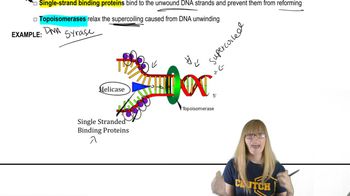
Steps to DNA Replication

DNA Polymerase I

DNA Polymerase I is an enzyme that plays a key role in DNA replication by removing RNA primers from the lagging strand and replacing them with DNA nucleotides. It also has proofreading capabilities, allowing it to correct errors during DNA synthesis, thus maintaining the integrity of the genetic information.
Recommended video:
Guided course
01:45
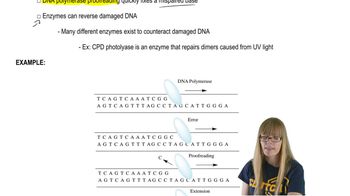
DNA Proofreading

DNA Polymerase III

DNA Polymerase III is the primary enzyme responsible for synthesizing new DNA strands during replication. It adds nucleotides to the growing DNA chain in a 5' to 3' direction and is essential for the rapid and accurate replication of the bacterial genome, making it a critical component of the replication machinery.
Recommended video:
Guided course
01:45
DNA Proofreading