Pearson+ LogoPearson+ Logo
Ch. 7 - DNA Structure and Replication
Sanders - Genetic Analysis: An Integrated Approach 3rd Edition
Sanders3rd EditionGenetic Analysis: An Integrated ApproachISBN: 9780135564172Not the one you use?Change textbook
Chapter 7, Problem 29

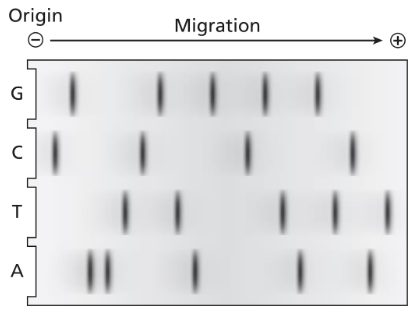
The following dideoxy DNA sequencing gel is produced in a laboratory.
Dideoxy DNA sequencing gel showing bands for G, C, T, and A, indicating DNA sequence and strand polarity.
What is the double-stranded DNA sequence of this molecule? Label the polarity of each strand.

Verified step by step guidance
1
Examine the dideoxy DNA sequencing gel. Identify the lanes corresponding to the four dideoxynucleotides (ddATP, ddTTP, ddCTP, ddGTP), which terminate DNA synthesis at specific bases (A, T, C, G).
Read the sequence from the bottom of the gel to the top, as the smallest fragments (closest to the primer) migrate the furthest. This sequence represents the newly synthesized strand in the 5' to 3' direction.
Determine the complementary strand by pairing the bases of the synthesized strand with their complementary bases (A pairs with T, and C pairs with G). Write this complementary strand in the 3' to 5' direction.
Label the polarity of both strands. The synthesized strand is 5' to 3', and the complementary strand is 3' to 5'.
Combine the information to write the double-stranded DNA sequence, ensuring that the polarity of each strand is clearly labeled (e.g., 5' to 3' for one strand and 3' to 5' for the complementary strand).

Verified video answer for a similar problem:

This video solution was recommended by our tutors as helpful for the problem above.
Video duration:
2m
Was this helpful?

Key Concepts

Here are the essential concepts you must grasp in order to answer the question correctly.

Dideoxy DNA Sequencing

Dideoxy DNA sequencing, also known as Sanger sequencing, is a method used to determine the nucleotide sequence of DNA. It involves the incorporation of dideoxynucleotides, which terminate DNA strand elongation during replication. This results in fragments of varying lengths that can be separated by gel electrophoresis, allowing for the identification of the sequence based on the size of the fragments.
Recommended video:
Guided course
08:41
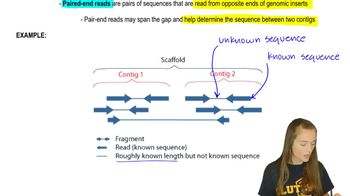
Sequencing Difficulties

Polarity of DNA Strands

DNA strands have polarity, indicated as 5' to 3' and 3' to 5'. The 5' end has a phosphate group, while the 3' end has a hydroxyl group. When determining the sequence from a gel, it is essential to label the strands correctly, as the 5' to 3' directionality affects how the DNA is synthesized and read during replication and sequencing.
Recommended video:
Guided course
03:03
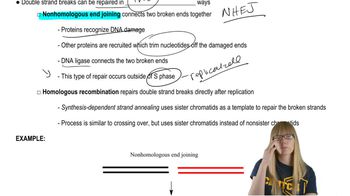
Double Strand Breaks

Gel Electrophoresis

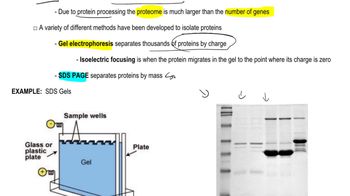
Gel electrophoresis is a technique used to separate DNA fragments based on their size. In the context of dideoxy sequencing, the DNA fragments produced during the sequencing reaction are loaded into a gel matrix and subjected to an electric field. Smaller fragments migrate faster than larger ones, allowing for the visualization of the sequence by comparing the positions of the bands on the gel.
Recommended video:
Related Practice
Textbook Question

In a dideoxy DNA sequencing experiment, four separate reactions are carried out to provide the replicated material for DNA sequencing gels. Reaction products are usually run in gel lanes labeled A, T, C, and G.

Identify the nucleotides used in the dideoxy DNA sequencing reaction that produces molecules for the A lane of the sequencing gel.

725
views
Textbook Question

In a dideoxy DNA sequencing experiment, four separate reactions are carried out to provide the replicated material for DNA sequencing gels. Reaction products are usually run in gel lanes labeled A, T, C, and G.

How does PCR play a role in dideoxy DNA sequencing?

548
views
Textbook Question

In a dideoxy DNA sequencing experiment, four separate reactions are carried out to provide the replicated material for DNA sequencing gels. Reaction products are usually run in gel lanes labeled A, T, C, and G.

Why is incorporation of a dideoxynucleotide during DNA sequencing identified as a 'replication-terminating' event?

542
views
Textbook Question

Using an illustration style and labeling, draw the electrophoresis gel containing dideoxy sequencing fragments for the DNA template strand 3'-AGACGATAGCAT-5'.

479
views
Textbook Question

A PCR reaction begins with one double-stranded segment of DNA. How many double-stranded copies of DNA are present after the completion of 10 amplification cycles? After 20 cycles? After 30 cycles?

563
views
Textbook Question

DNA replication in early Drosophila embryos occurs about every 5 minutes. The Drosophila genome contains approximately 1.8×10⁸ base pairs. Eukaryotic DNA polymerases synthesize DNA at a rate of approximately 40 nucleotides per second. Approximately how many origins of replication are required for this rate of replication?

739
views