Pearson+ LogoPearson+ Logo
Ch. 7 - DNA Structure and Replication
Sanders - Genetic Analysis: An Integrated Approach 3rd Edition
Sanders3rd EditionGenetic Analysis: An Integrated ApproachISBN: 9780135564172Not the one you use?Change textbook
Chapter 7, Problem 31

A PCR reaction begins with one double-stranded segment of DNA. How many double-stranded copies of DNA are present after the completion of 10 amplification cycles? After 20 cycles? After 30 cycles?

Verified step by step guidance
1
Understand the principle of PCR (Polymerase Chain Reaction): In each cycle of PCR, the number of double-stranded DNA molecules doubles. This is an exponential process, where the number of DNA molecules after n cycles can be calculated using the formula: \( N = N_0 \times 2^n \), where \( N_0 \) is the initial number of DNA molecules (in this case, 1), and \( n \) is the number of cycles.
Identify the given values: The initial number of DNA molecules \( N_0 \) is 1. You are asked to calculate the number of DNA molecules after 10, 20, and 30 cycles. These correspond to \( n = 10 \), \( n = 20 \), and \( n = 30 \).
Substitute the values into the formula for each case: For 10 cycles, the formula becomes \( N = 1 \times 2^{10} \). For 20 cycles, it becomes \( N = 1 \times 2^{20} \). For 30 cycles, it becomes \( N = 1 \times 2^{30} \).
Simplify the expressions: Use the properties of exponents to calculate \( 2^{10} \), \( 2^{20} \), and \( 2^{30} \). These values represent the number of double-stranded DNA molecules after the respective number of cycles.
Interpret the results: The calculated values represent the exponential growth of DNA molecules during PCR. This demonstrates how PCR can rapidly amplify DNA, making it a powerful tool in molecular biology.

Verified video answer for a similar problem:

This video solution was recommended by our tutors as helpful for the problem above.
Video duration:
1m
Was this helpful?

Key Concepts

Here are the essential concepts you must grasp in order to answer the question correctly.

Polymerase Chain Reaction (PCR)

PCR is a molecular biology technique used to amplify specific segments of DNA. It involves repeated cycles of denaturation, annealing, and extension, allowing for exponential replication of the target DNA sequence. Each cycle theoretically doubles the amount of DNA, making it a powerful tool for genetic analysis.
Recommended video:
Guided course
07:39
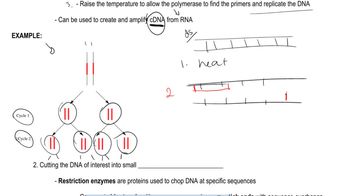
Genetic Cloning

Exponential Growth in PCR

In PCR, the amount of DNA doubles with each cycle, leading to exponential growth. The formula to calculate the number of DNA copies after 'n' cycles is 2^n, where 'n' is the number of cycles. This means that after 10 cycles, there would be 2^10 (1,024) copies, after 20 cycles, 2^20 (1,048,576) copies, and after 30 cycles, 2^30 (1,073,741,824) copies.
Recommended video:
Guided course
04:17
Traditional vs. Next-Gen

Double-Stranded DNA

Double-stranded DNA consists of two complementary strands that form a helical structure. In the context of PCR, each cycle produces new double-stranded DNA molecules from the original template. Understanding the nature of double-stranded DNA is crucial for grasping how PCR amplifies genetic material effectively.
Recommended video:
Guided course
03:03
Double Strand Breaks