Pearson+ LogoPearson+ Logo
Ch. 7 - DNA Structure and Replication
Sanders - Genetic Analysis: An Integrated Approach 3rd Edition
Sanders3rd EditionGenetic Analysis: An Integrated ApproachISBN: 9780135564172Not the one you use?Change textbook
Chapter 7, Problem 19

Two viral genomes are sequenced, and the following percentages of nucleotides are identified:
Genome 1: A=28%, C=22%,G=28%,T=22%
Genome 2: A=22%, C=28%,G=28%,T=22%
Are the DNA molecules in each genome single-stranded or double-stranded?

Verified step by step guidance
1
Analyze the nucleotide composition of each genome. In double-stranded DNA, the base pairing rule (Chargaff's rule) states that the percentage of adenine (A) equals the percentage of thymine (T), and the percentage of cytosine (C) equals the percentage of guanine (G). This is because A pairs with T, and C pairs with G in double-stranded DNA.
For Genome 1, compare the percentages of A and T, and C and G. Here, A = 28% and T = 22%, which are not equal. Similarly, C = 22% and G = 28%, which are also not equal. This suggests that Genome 1 does not follow Chargaff's rule and is likely single-stranded.
For Genome 2, compare the percentages of A and T, and C and G. Here, A = 22% and T = 22%, which are equal. Similarly, C = 28% and G = 28%, which are also equal. This indicates that Genome 2 follows Chargaff's rule and is likely double-stranded.
Summarize the findings: Genome 1 is single-stranded because it does not follow Chargaff's rule, while Genome 2 is double-stranded because it adheres to Chargaff's rule.
Conclude by emphasizing the importance of Chargaff's rule in determining whether a DNA molecule is single-stranded or double-stranded, based on the nucleotide composition.

Verified video answer for a similar problem:

This video solution was recommended by our tutors as helpful for the problem above.
Video duration:
3m
Was this helpful?

Key Concepts

Here are the essential concepts you must grasp in order to answer the question correctly.

Base Pairing Rules

In double-stranded DNA, nucleotides pair specifically: adenine (A) pairs with thymine (T), and cytosine (C) pairs with guanine (G). This complementary base pairing is crucial for the stability and replication of DNA. In single-stranded DNA, these pairing rules do not apply, as there is no complementary strand to bind with.
Recommended video:
Guided course
03:49
Base Distortions

Nucleotide Composition

The composition of nucleotides in a genome can provide insights into its structure. In double-stranded DNA, the percentages of A and T should be roughly equal, as should the percentages of C and G, due to base pairing. In contrast, single-stranded DNA does not exhibit this complementary relationship, leading to potentially unequal nucleotide ratios.
Recommended video:
Guided course
06:51
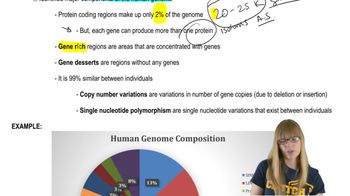
Human Genome Composition

Genome Structure

The overall structure of a genome influences its function and stability. Double-stranded DNA forms a helical structure that is more stable and less prone to degradation than single-stranded DNA. Understanding whether a genome is single or double-stranded is essential for interpreting its biological properties and behavior during processes like replication and transcription.
Recommended video:
Guided course
02:48
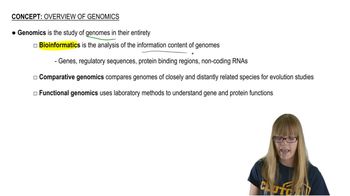
Genomics Overview