Pearson+ LogoPearson+ Logo
Ch. 7 - DNA Structure and Replication
Sanders - Genetic Analysis: An Integrated Approach 3rd Edition
Sanders3rd EditionGenetic Analysis: An Integrated ApproachISBN: 9780135564172Not the one you use?Change textbook
Chapter 7, Problem 17c

Which of the following equalities is not true for double-stranded DNA?
(G+A)=(C+T)

Verified step by step guidance
1
Understand the structure of double-stranded DNA: DNA is composed of two complementary strands where adenine (A) pairs with thymine (T) and guanine (G) pairs with cytosine (C). This is known as Chargaff's rule.
Recall Chargaff's rule: In double-stranded DNA, the amount of adenine (A) equals the amount of thymine (T), and the amount of guanine (G) equals the amount of cytosine (C). Mathematically, this can be expressed as A = T and G = C.
Combine the base-pairing rules: Since A = T and G = C, the total purines (A + G) will equal the total pyrimidines (T + C). This can be expressed as (A + G) = (T + C).
Analyze the given equality: The problem states (G + A) = (C + T). This equality is consistent with the base-pairing rules and Chargaff's rule, as it reflects the balance between purines and pyrimidines in double-stranded DNA.
Conclude whether the equality is true: Based on the rules of DNA base pairing and Chargaff's observations, the given equality (G + A) = (C + T) is indeed true for double-stranded DNA. Therefore, there is no contradiction in this equality.

Verified video answer for a similar problem:

This video solution was recommended by our tutors as helpful for the problem above.
Video duration:
3m
Was this helpful?

Key Concepts

Here are the essential concepts you must grasp in order to answer the question correctly.

Base Pairing Rules

In double-stranded DNA, the base pairing rules dictate that adenine (A) pairs with thymine (T) and guanine (G) pairs with cytosine (C). This complementary pairing is crucial for the stability of the DNA structure and ensures accurate replication and transcription processes.
Recommended video:
Guided course
03:49
Base Distortions

Chargaff's Rules

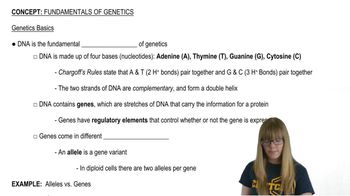
Chargaff's rules state that in any given DNA molecule, the amount of adenine (A) is equal to thymine (T), and the amount of guanine (G) is equal to cytosine (C). This principle is fundamental in understanding the stoichiometry of DNA and is essential for analyzing the equality presented in the question.
Recommended video:
Guided course
08:44
Genetics Basics

DNA Composition

The composition of double-stranded DNA includes four nucleotide bases: adenine, thymine, guanine, and cytosine. The total number of purines (A and G) should equal the total number of pyrimidines (C and T) in a double-stranded DNA molecule, which is a key aspect to evaluate the validity of the given equality.
Recommended video:
Guided course
01:45
DNA Proofreading