Pearson+ LogoPearson+ Logo
Ch. 7 - DNA Structure and Replication
Sanders - Genetic Analysis: An Integrated Approach 3rd Edition
Sanders3rd EditionGenetic Analysis: An Integrated ApproachISBN: 9780135564172Not the one you use?Change textbook
Chapter 7, Problem 18

List the order in which the following proteins and enzymes are active in E. coli DNA replication: DNA pol I, SSB, ligase, helicase, DNA pol III, and primase.

Verified step by step guidance
1
Understand the process of DNA replication in E. coli, which involves unwinding the DNA, stabilizing the strands, synthesizing primers, elongating the new strands, and sealing the gaps.
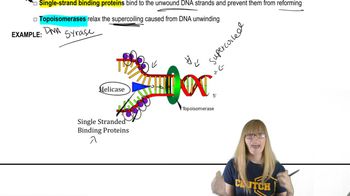
The first enzyme to act is helicase, which unwinds the DNA double helix at the replication fork by breaking hydrogen bonds between complementary bases.
Next, single-strand binding proteins (SSB) bind to the separated DNA strands to prevent them from reannealing and to protect them from degradation.
Primase synthesizes short RNA primers on the lagging strand (and occasionally on the leading strand) to provide a starting point for DNA polymerase to begin synthesis.
DNA polymerase III (DNA pol III) extends the RNA primers by adding nucleotides in the 5' to 3' direction, synthesizing the bulk of the new DNA strand. DNA polymerase I (DNA pol I) later replaces the RNA primers with DNA, and DNA ligase seals the nicks in the sugar-phosphate backbone to complete the replication process.

Verified video answer for a similar problem:

This video solution was recommended by our tutors as helpful for the problem above.
Video duration:
2m
Was this helpful?

Key Concepts

Here are the essential concepts you must grasp in order to answer the question correctly.

DNA Replication Process

DNA replication in E. coli is a highly coordinated process involving multiple enzymes and proteins that work in a specific order to ensure accurate duplication of the genetic material. The process begins at the origin of replication and proceeds bidirectionally, requiring the unwinding of the DNA double helix and the synthesis of new strands complementary to the original template.
Recommended video:
Guided course
11:59
Steps to DNA Replication

Role of Key Enzymes

Each enzyme involved in DNA replication has a distinct role. Helicase unwinds the DNA double helix, single-strand binding proteins (SSB) stabilize the unwound strands, primase synthesizes RNA primers, DNA polymerase III extends the new DNA strand, DNA polymerase I replaces RNA primers with DNA, and ligase seals the gaps between Okazaki fragments on the lagging strand.
Recommended video:

Order of Enzyme Activity

The order of enzyme activity during E. coli DNA replication is crucial for the process's efficiency and accuracy. It typically follows this sequence: helicase, SSB, primase, DNA pol III, DNA pol I, and finally ligase. Understanding this sequence helps clarify how each enzyme contributes to the overall replication process and ensures that the DNA is copied correctly.
Recommended video:
Guided course
10:14
Prokaryotic Transcription