Pearson+ LogoPearson+ Logo
Ch. 7 - DNA Structure and Replication
Sanders - Genetic Analysis: An Integrated Approach 3rd Edition
Sanders3rd EditionGenetic Analysis: An Integrated ApproachISBN: 9780135564172Not the one you use?Change textbook
Chapter 7, Problem 20

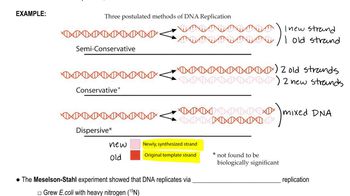
Matthew Meselson and Franklin Stahl demonstrated that DNA replication is semiconservative in bacteria. Briefly outline their experiment and its results for two DNA replication cycles, and identify how the alternative models of DNA replication were excluded by the data.

Verified step by step guidance
1
Meselson and Stahl grew *Escherichia coli* in a medium containing heavy nitrogen isotope (¹⁵N) so that the DNA incorporated the heavier isotope, making it denser. This was the starting point for their experiment.
The bacteria were then transferred to a medium containing the lighter nitrogen isotope (¹⁴N) and allowed to replicate. After one replication cycle, DNA was extracted and analyzed using density gradient centrifugation to separate DNA based on its density.
After the first replication cycle, the DNA formed a single intermediate-density band, which was consistent with the semiconservative model (one strand ¹⁵N and one strand ¹⁴N) and excluded the conservative model (which would predict one heavy band and one light band).
The bacteria were allowed to replicate for a second cycle in the ¹⁴N medium. After this cycle, the DNA formed two distinct bands: one of intermediate density and one of light density. This result further supported the semiconservative model and excluded the dispersive model (which would predict a single band of intermediate density that becomes lighter over time).
The semiconservative model was confirmed because the data showed that each new DNA molecule consisted of one original (¹⁵N-labeled) strand and one newly synthesized (¹⁴N-labeled) strand after the first cycle, and subsequent cycles produced more DNA with only ¹⁴N strands.

Verified video answer for a similar problem:

This video solution was recommended by our tutors as helpful for the problem above.
Video duration:
2m
Was this helpful?

Key Concepts

Here are the essential concepts you must grasp in order to answer the question correctly.

Semiconservative Replication

Semiconservative replication is the process by which DNA makes copies of itself, where each new DNA molecule consists of one original strand and one newly synthesized strand. This model was proposed to explain how genetic information is accurately passed on during cell division, ensuring that each daughter cell receives an exact copy of the DNA.
Recommended video:
Guided course
14:31
Semiconservative Replication

Meselson-Stahl Experiment

The Meselson-Stahl experiment utilized isotopes of nitrogen to label DNA in bacteria. By growing E. coli in a medium containing heavy nitrogen (N-15) and then transferring them to a medium with light nitrogen (N-14), they analyzed the density of the DNA after one and two replication cycles. The results showed that after one cycle, the DNA had an intermediate density, and after two cycles, there were both light and intermediate density DNA, supporting the semiconservative model.
Recommended video:
Guided course
08:06
Mendel's Experiments

Exclusion of Alternative Models

The alternative models of DNA replication included conservative and dispersive replication. The conservative model suggested that the original DNA strands remained together, while the dispersive model proposed that parental and new DNA would be interspersed. The results of the Meselson-Stahl experiment, showing distinct bands of DNA density, effectively excluded these models, as they could not account for the observed intermediate density after one replication cycle.
Recommended video:
Guided course
01:57
Alternative DNA Forms