
Pearson+ LogoPearson+ Logo
Ch. 8 - Molecular Biology of Transcription and RNA Processing
Sanders - Genetic Analysis: An Integrated Approach 3rd Edition
Sanders3rd EditionGenetic Analysis: An Integrated ApproachISBN: 9780135564172Not the one you use?Change textbook
Chapter 8, Problem 19a

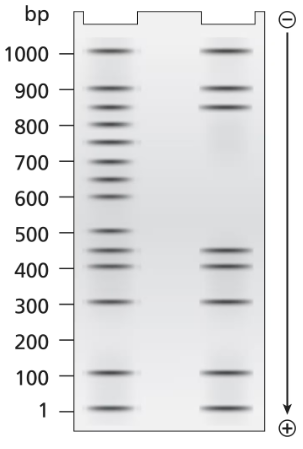
A 1.0-kb DNA fragment from the end of the mouse gene described in the previous problem is examined by DNA footprint protection analysis. Two samples are end-labeled with ³²P and one of the two is mixed with TFIIB, TFIID, and RNA polymerase II. The DNA exposed to these proteins is run in the right-hand lane of the gel shown below and the control DNA is run in the left-hand. Both DNA samples are treated with DNase I before running the samples on the electrophoresis gel.
What length of DNA is bound by the transcriptional proteins? Explain how the gel results support this interpretation.
Electrophoresis gel showing DNA fragments, with size markers from 100 to 1000 base pairs on the left.

Verified step by step guidance
1
Step 1: Understand the DNA footprinting technique. DNA footprinting is used to identify the region of DNA bound by proteins. DNase I cleaves unprotected DNA, but regions bound by proteins are protected and do not get cleaved. This results in a 'footprint' on the gel where no bands appear, corresponding to the protected region.
Step 2: Analyze the gel lanes. The left-hand lane represents the control DNA (no proteins added), which shows a ladder of bands corresponding to DNA fragments of various lengths cleaved by DNase I. The right-hand lane represents the DNA sample mixed with TFIIB, TFIID, and RNA polymerase II, where certain bands are missing due to the protection provided by the bound proteins.
Step 3: Identify the missing bands in the right-hand lane. Compare the right-hand lane to the left-hand lane to determine which bands are absent. The absence of these bands indicates the region of DNA that is protected by the transcriptional proteins.
Step 4: Calculate the length of the protected DNA. Use the molecular weight markers or the known sizes of the DNA fragments in the gel to estimate the size of the protected region. The difference between the start and end of the missing bands corresponds to the length of DNA bound by the proteins.
Step 5: Interpret the results. The missing bands in the right-hand lane indicate the specific region of DNA bound by TFIIB, TFIID, and RNA polymerase II. This region corresponds to the length of DNA protected from DNase I digestion, which is the answer to the question.

Verified video answer for a similar problem:

This video solution was recommended by our tutors as helpful for the problem above.
Video duration:
2m
Was this helpful?

Key Concepts

Here are the essential concepts you must grasp in order to answer the question correctly.

DNA Footprint Protection Analysis

DNA footprint protection analysis is a technique used to identify the specific binding sites of proteins on DNA. When proteins bind to DNA, they protect certain regions from being cleaved by DNase I, an enzyme that cuts DNA. By comparing the patterns of DNA fragments before and after protein binding, researchers can determine which segments of DNA are protected, indicating where transcription factors or other proteins interact with the DNA.
Recommended video:
Guided course
02:48
Chi Square Analysis

Transcription Factors and RNA Polymerase II

Transcription factors are proteins that bind to specific DNA sequences to regulate gene expression. In this context, TFIIB and TFIID are essential transcription factors that assist RNA polymerase II in initiating transcription. The presence of these proteins on the DNA fragment indicates that they are involved in the transcription process, and their binding can be inferred from the protected regions observed in the gel analysis.
Recommended video:
Guided course
09:16
Eukaryotic Transcription

Electrophoresis and Gel Analysis

Electrophoresis is a laboratory technique used to separate DNA fragments based on their size by applying an electric field to a gel matrix. In this experiment, the DNA samples are run on a gel after treatment with DNase I, allowing visualization of the protected and unprotected fragments. The difference in band patterns between the control and experimental samples reveals the length of DNA bound by the transcriptional proteins, as the protected regions will show fewer or no bands compared to the unprotected control.
Recommended video:
Guided course
02:48
Chi Square Analysis
Related Practice
Textbook Question

A 3.5-kb segment of DNA containing the complete sequence of a mouse gene is available. The DNA segment contains the promoter sequence and extends beyond the polyadenylation site of the gene. The DNA is studied by band shift assay, and the following gel bands are observed.

Match these conditions to a specific lane of the gel.

3.5-kb fragment alone

366
views
Textbook Question

A 3.5-kb segment of DNA containing the complete sequence of a mouse gene is available. The DNA segment contains the promoter sequence and extends beyond the polyadenylation site of the gene. The DNA is studied by band shift assay, and the following gel bands are observed.

Match these conditions to a specific lane of the gel.

3.5-kb fragment plus RNA polymerase II

354
views
Textbook Question

A 3.5-kb segment of DNA containing the complete sequence of a mouse gene is available. The DNA segment contains the promoter sequence and extends beyond the polyadenylation site of the gene. The DNA is studied by band shift assay, and the following gel bands are observed.

Match these conditions to a specific lane of the gel.

3.5-kb fragment plus TFIIB

473
views
Textbook Question

A 1.0-kb DNA fragment from the end of the mouse gene described in the previous problem is examined by DNA footprint protection analysis. Two samples are end-labeled with ³²P, and one of the two is mixed with TFIIB, TFIID, and RNA polymerase II. The DNA exposed to these proteins is run in the right-hand lane of the gel shown below and the control DNA is run in the left-hand. Both DNA samples are treated with DNase I before running the samples on the electrophoresis gel.

Draw a diagram of this DNA fragment bound by the transcriptional proteins, showing the approximate position of proteins along the fragment.

471
views
Textbook Question

A 1.0-kb DNA fragment from the end of the mouse gene described in the previous problem is examined by DNA footprint protection analysis. Two samples are end-labeled with ³²P and one of the two is mixed with TFIIB, TFIID, and RNA polymerase II. The DNA exposed to these proteins is run in the right-hand lane of the gel shown below and the control DNA is run in the left-hand. Both DNA samples are treated with DNase I before running the samples on the electrophoresis gel.

Explain the role of DNase I.

467
views
Textbook Question

Wild-type E. coli grow best at 37°C but can grow efficiently up to 42°C. An E. coli strain has a mutation of the sigma subunit that results in an RNA polymerase holoenzyme that is stable and transcribes at wild-type levels at 37°C. The mutant holoenzyme is progressively destabilized as the temperature is raised, and it completely denatures and ceases to carry out transcription at 42°C. Relative to wild-type growth, characterize the ability of the mutant strain to carry out transcription at 37°C

481
views