Pearson+ LogoPearson+ Logo
Ch. 8 - Molecular Biology of Transcription and RNA Processing
Sanders - Genetic Analysis: An Integrated Approach 3rd Edition
Sanders3rd EditionGenetic Analysis: An Integrated ApproachISBN: 9780135564172Not the one you use?Change textbook
Chapter 8, Problem 25a

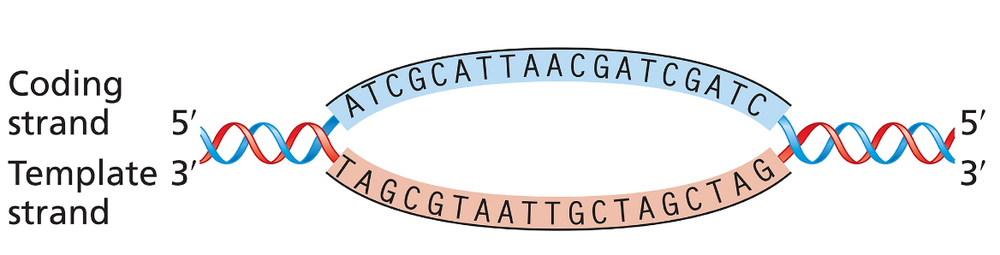
The accompanying illustration shows a portion of a gene undergoing transcription. The template and coding strands for the gene are labeled, and a segment of DNA sequence is given.

For this gene segment, superimpose a drawing of RNA polymerase as it nears the end of transcription of the DNA sequence.

Verified step by step guidance
1
Understand the process of transcription: Transcription is the process by which RNA polymerase synthesizes a complementary RNA strand from the DNA template strand. The RNA sequence will be complementary to the template strand and identical (except for uracil replacing thymine) to the coding strand.
Identify the direction of transcription: RNA polymerase moves along the DNA template strand in the 3' to 5' direction, synthesizing the RNA strand in the 5' to 3' direction. Ensure you know which end of the DNA sequence corresponds to 3' and 5'.
Locate the RNA polymerase position: Since the problem states that RNA polymerase is nearing the end of transcription, it should be positioned close to the 5' end of the template strand (or the 3' end of the coding strand).
Superimpose the RNA polymerase: Draw the RNA polymerase as a large enzyme complex near the end of the template strand. Ensure that the RNA strand being synthesized is shown emerging from the RNA polymerase in the 5' to 3' direction.
Label the components: Clearly label the template strand, coding strand, RNA polymerase, and the RNA strand being synthesized. This will help clarify the relationships between the DNA and RNA during transcription.

Verified video answer for a similar problem:

This video solution was recommended by our tutors as helpful for the problem above.
Video duration:
4m
Was this helpful?

Key Concepts

Here are the essential concepts you must grasp in order to answer the question correctly.

Transcription

Transcription is the process by which the genetic information encoded in DNA is copied into messenger RNA (mRNA). During this process, RNA polymerase binds to the DNA template strand and synthesizes a complementary RNA strand. This occurs in three main stages: initiation, elongation, and termination, with RNA polymerase playing a crucial role in catalyzing the formation of RNA from the DNA template.
Recommended video:
Guided course
09:16
Eukaryotic Transcription

RNA Polymerase

RNA polymerase is the enzyme responsible for synthesizing RNA from a DNA template during transcription. It unwinds the DNA double helix and adds ribonucleotides to the growing RNA strand in a 5' to 3' direction. The enzyme also recognizes specific promoter regions on the DNA to initiate transcription and is involved in terminating the process once a termination signal is reached.
Recommended video:

Gene Structure

A gene consists of sequences of DNA that encode instructions for synthesizing proteins. It typically includes regulatory regions, exons (coding sequences), and introns (non-coding sequences). Understanding the structure of a gene is essential for comprehending how transcription occurs, as it determines where RNA polymerase binds and how the resulting mRNA is processed before translation into proteins.
Recommended video:
Guided course
03:49
Ribosome Structure
Related Practice
Textbook Question

Microbiologists describe the processes of transcription and translation as 'coupled' in bacteria. This term indicates that a bacterial mRNA can be undergoing transcription at the same moment it is also undergoing translation.

How is coupling of transcription and translation possible in bacteria?

821
views
Textbook Question

A full-length eukaryotic gene is inserted into a bacterial chromosome. The gene contains a complete promoter sequence and a functional polyadenylation sequence, and it has wild-type nucleotides throughout the transcribed region. However, the gene fails to produce a functional protein. List at least three possible reasons why this eukaryotic gene is not expressed in bacteria.

497
views
Textbook Question

A full-length eukaryotic gene is inserted into a bacterial chromosome. The gene contains a complete promoter sequence and a functional polyadenylation sequence, and it has wild-type nucleotides throughout the transcribed region. However, the gene fails to produce a functional protein. What changes would you recommend to permit expression of this eukaryotic gene in a bacterial cell?

379
views
Textbook Question

The accompanying illustration shows a portion of a gene undergoing transcription. The template and coding strands for the gene are labeled, and a segment of DNA sequence is given.

For this gene segment indicate the direction in which RNA polymerase moves as it transcribes this gene.

579
views
Textbook Question

The accompanying illustration shows a portion of a gene undergoing transcription. The template and coding strands for the gene are labeled, and a segment of DNA sequence is given.

For this gene segment, write the polarity and sequence [TIP 1] of the RNA transcript from the DNA sequence given.

578
views
Textbook Question

The accompanying illustration shows a portion of a gene undergoing transcription. The template and coding strands for the gene are labeled, and a segment of DNA sequence is given.

For this gene segment identify the direction in which the promoter [TIP 2] for this gene is located.

715
views