Pearson+ LogoPearson+ Logo
Ch. 8 - Molecular Biology of Transcription and RNA Processing
Sanders - Genetic Analysis: An Integrated Approach 3rd Edition
Sanders3rd EditionGenetic Analysis: An Integrated ApproachISBN: 9780135564172Not the one you use?Change textbook
Chapter 8, Problem 25b

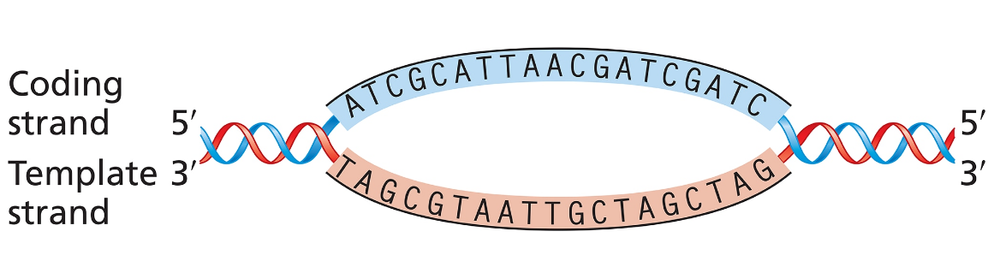
The accompanying illustration shows a portion of a gene undergoing transcription. The template and coding strands for the gene are labeled, and a segment of DNA sequence is given.
Illustration of a gene's transcription, showing coding and template strands with RNA polymerase direction indicated.
For this gene segment indicate the direction in which RNA polymerase moves as it transcribes this gene.

Verified step by step guidance
1
Examine the provided illustration to identify the orientation of the template strand and the coding strand. The template strand is the one used by RNA polymerase to synthesize RNA, while the coding strand has the same sequence as the RNA (except thymine is replaced by uracil).
Determine the 5' to 3' directionality of both the template and coding strands. DNA strands are antiparallel, meaning the 5' end of one strand aligns with the 3' end of the other.
Recall that RNA polymerase synthesizes RNA in the 5' to 3' direction. This means it reads the template strand in the 3' to 5' direction.
Using the orientation of the template strand (3' to 5'), deduce the direction in which RNA polymerase moves along the DNA during transcription.
Confirm your conclusion by checking the sequence of the RNA being synthesized. The RNA sequence should complement the template strand and match the coding strand (with uracil replacing thymine).

Verified video answer for a similar problem:

This video solution was recommended by our tutors as helpful for the problem above.
Video duration:
2m
Was this helpful?

Key Concepts

Here are the essential concepts you must grasp in order to answer the question correctly.

Transcription Process

Transcription is the process by which RNA polymerase synthesizes RNA from a DNA template. During this process, the enzyme reads the DNA sequence and constructs a complementary RNA strand. This occurs in the nucleus of eukaryotic cells and is essential for gene expression, as it converts genetic information from DNA into a form that can be translated into proteins.
Recommended video:
Guided course
08:39
mRNA Processing

Directionality of RNA Synthesis

RNA polymerase synthesizes RNA in a 5' to 3' direction, meaning it adds nucleotides to the 3' end of the growing RNA strand. This directionality is crucial because it determines how the RNA strand is built and how it will eventually be translated into proteins. Understanding this directionality helps clarify how the RNA polymerase interacts with the DNA template strand.
Recommended video:

Template and Coding Strands

In transcription, the DNA double helix consists of two strands: the template strand and the coding strand. The template strand is the one that RNA polymerase reads to synthesize RNA, while the coding strand has the same sequence as the RNA (except for uracil replacing thymine). Recognizing which strand serves as the template is essential for determining the direction of RNA polymerase movement during transcription.
Recommended video:
Guided course
11:43
The Genetic Code
Related Practice
Textbook Question

A full-length eukaryotic gene is inserted into a bacterial chromosome. The gene contains a complete promoter sequence and a functional polyadenylation sequence, and it has wild-type nucleotides throughout the transcribed region. However, the gene fails to produce a functional protein. List at least three possible reasons why this eukaryotic gene is not expressed in bacteria.

497
views
Textbook Question

A full-length eukaryotic gene is inserted into a bacterial chromosome. The gene contains a complete promoter sequence and a functional polyadenylation sequence, and it has wild-type nucleotides throughout the transcribed region. However, the gene fails to produce a functional protein. What changes would you recommend to permit expression of this eukaryotic gene in a bacterial cell?

379
views
Textbook Question

The accompanying illustration shows a portion of a gene undergoing transcription. The template and coding strands for the gene are labeled, and a segment of DNA sequence is given.

For this gene segment, superimpose a drawing of RNA polymerase as it nears the end of transcription of the DNA sequence.

734
views
Textbook Question

The accompanying illustration shows a portion of a gene undergoing transcription. The template and coding strands for the gene are labeled, and a segment of DNA sequence is given.

For this gene segment, write the polarity and sequence [TIP 1] of the RNA transcript from the DNA sequence given.

578
views
Textbook Question

The accompanying illustration shows a portion of a gene undergoing transcription. The template and coding strands for the gene are labeled, and a segment of DNA sequence is given.

For this gene segment identify the direction in which the promoter [TIP 2] for this gene is located.

715
views
Textbook Question

DNA footprint protection is a method that determines whether proteins bind to a specific sample of DNA and thus protect part of the DNA from random enzymatic cleavage by DNase I. A 400-bp segment of cloned DNA is thought to contain a promoter. The cloned DNA is analyzed by DNA footprinting to help determine if it has the capacity to act as a promoter sequence. The accompanying gel has two lanes, each containing the cloned 400-bp DNA fragment treated with DNase I to randomly cleave unprotected DNA. Lane 1 is cloned DNA that was mixed with RNA polymerase II and several TFII transcription factors before exposure to DNase I. Lane 2 contains cloned DNA that was exposed only to DNase I. RNA pol II and TFIIs were not mixed with that DNA before adding DNase I. Explain why this gel provides evidence that the cloned DNA may act as a promoter sequence.

802
views