Pearson+ LogoPearson+ Logo
Ch. 9 - The Molecular Biology of Translation
Sanders - Genetic Analysis: An Integrated Approach 3rd Edition
Sanders3rd EditionGenetic Analysis: An Integrated ApproachISBN: 9780135564172Not the one you use?Change textbook
Chapter 9, Problem B.6c

A couple and some of their relatives are screened for Gaucher disease in a community-based screening program. The woman is homozygous for the dominant allele, represented by G. The woman's father, sister, and paternal grandmother are heterozygous carriers of the mutant allele, represented by g. Her paternal grandfather, her mother, and both of her mother's parents are homozygous for the dominant allele. The man is heterozygous and he has a brother with Gaucher disease. The man's parents and grandparents have not been tested, but it is known that none of them has Gaucher disease.
Explain why you are able to assign genotypes to the man's parents despite their not being tested.

Verified step by step guidance
1
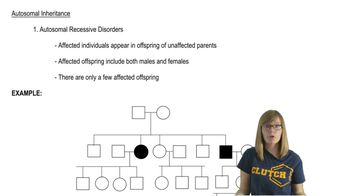
Recall that Gaucher disease is typically inherited in an autosomal recessive manner, meaning that an individual must have two copies of the mutant allele (gg) to express the disease phenotype.
Since the man's brother has Gaucher disease, he must be homozygous recessive (gg), which means both parents must have contributed a mutant allele to him.
Because the parents do not have Gaucher disease themselves, they cannot be homozygous recessive (gg); therefore, each parent must be heterozygous carriers (Gg) of the mutant allele.
This reasoning allows us to assign the genotype Gg to both of the man's parents, even though they have not been tested, because they must each carry one mutant allele to have an affected child.
The fact that none of the man's grandparents have Gaucher disease supports the idea that the mutant allele is present in a heterozygous state in the parents, as the disease is recessive and would manifest only if two copies of the mutant allele were inherited.

Verified video answer for a similar problem:

This video solution was recommended by our tutors as helpful for the problem above.
Video duration:
4m
Was this helpful?

Key Concepts

Here are the essential concepts you must grasp in order to answer the question correctly.

Autosomal Recessive Inheritance

Gaucher disease is inherited in an autosomal recessive manner, meaning an individual must inherit two copies of the mutant allele (gg) to express the disease. Carriers (Gg) have one normal and one mutant allele but do not show symptoms. Understanding this pattern helps infer genotypes based on affected or unaffected status within a family.
Recommended video:
Guided course
09:08
Autosomal Pedigrees

Genotype Inference from Phenotype and Family History

Even without direct testing, genotypes can be deduced by analyzing the presence or absence of disease in relatives. Since the man is heterozygous (Gg) and has an affected brother (gg), both parents must carry at least one mutant allele, making them obligate carriers (Gg), despite no symptoms.
Recommended video:
Guided course
11:35
History of Genetics

Dominant vs. Recessive Allele Notation and Interpretation

In this question, the dominant allele (G) is normal, and the recessive allele (g) causes disease when homozygous. Recognizing the difference between dominant and recessive alleles and their phenotypic effects is essential to correctly assign genotypes and understand inheritance patterns.
Recommended video:
Guided course
04:37
Variations on Dominance
Related Practice
Textbook Question

Homocystinuria is a rare autosomal recessive condition on the RUSP list of conditions screened by newborn genetic testing. The condition results from a mutation that blocks the degradation of the amino acid methionine. The absence of a critical enzyme causes the buildup of the compound homocysteine, which is one of the intermediate compounds in the methionine breakdown pathway. Homocystinuria causes mental impairment, heart problems, seizures, eye abnormalities, and a number of other symptoms that shorten life if not treated. The condition is treated by a specialized diet that is low in methionine and by the ingestion of several supplements.

The low-methionine diet must be maintained throughout life to manage homocystinuria. Why do you think this is the case?

389
views
Textbook Question

A couple and some of their relatives are screened for Gaucher disease in a community-based screening program. The woman is homozygous for the dominant allele, represented by G. The woman's father, sister, and paternal grandmother are heterozygous carriers of the mutant allele, represented by g. Her paternal grandfather, her mother, and both of her mother's parents are homozygous for the dominant allele. The man is heterozygous and he has a brother with Gaucher disease. The man's parents and grandparents have not been tested, but it is known that none of them has Gaucher disease.

Draw a pedigree of this family, including the woman, the man, their siblings, parents, and grandparents.

375
views
Textbook Question

A couple and some of their relatives are screened for Gaucher disease in a community-based screening program. The woman is homozygous for the dominant allele, represented by G. The woman's father, sister, and paternal grandmother are heterozygous carriers of the mutant allele, represented by g. Her paternal grandfather, her mother, and both of her mother's parents are homozygous for the dominant allele. The man is heterozygous and he has a brother with Gaucher disease. The man's parents and grandparents have not been tested, but it is known that none of them has Gaucher disease.

On the pedigree, write the genotypes (GG, Gg, or gg) for each person who has been tested or for whom you can deduce a genotype. If a genotype cannot be determined completely, list the alleles you know or deduce must be present.

385
views
Textbook Question

If a man and a woman are each heterozygous carriers of a mutation causing a disease on the RUSP list, what do you think are the three or four most important factors they should consider in their decision making about having children?

649
views
Textbook Question

Suppose a man and a woman are each heterozygous carriers of a mutation causing a fatal hereditary disease not on the RUSP list. Prenatal genetic testing can identify the genotype of a fetus with regard to this disease and can identify fetuses with the disease. What do you think are the three or four most important factors this couple should consider in their decision making about having children?

551
views
Textbook Question

If you were to look up Gaucher disease on the OMIM website, you would see that there are three major types, designated Type I (OMIM 230800), Type II (OMIM 230900), and Type III (OMIM 231000). All three types are mutations of the gene for acid-β-glucosidase, encoded on chromosome 1. Different mutations of this gene produce the three types of Gaucher disease that differ somewhat in their symptoms and disease severity.

For each mutation, speculate about whether the acid-β-glucosidase enzyme is merely reduced in function or whether its production is eliminated, and explain why.

488
views