Pearson+ LogoPearson+ Logo
Ch. 9 - The Molecular Biology of Translation
Sanders - Genetic Analysis: An Integrated Approach 3rd Edition
Sanders3rd EditionGenetic Analysis: An Integrated ApproachISBN: 9780135564172Not the one you use?Change textbook
Chapter 9, Problem B.9

If a man and a woman are each heterozygous carriers of a mutation causing a disease on the RUSP list, what do you think are the three or four most important factors they should consider in their decision making about having children?

Verified step by step guidance
1
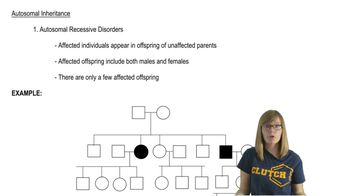
Understand that being heterozygous carriers means each parent has one normal allele and one mutated allele for the disease gene, which is typically autosomal recessive in nature.
Recognize that if both parents are carriers, there is a 25% chance with each pregnancy that the child will inherit two mutated alleles and be affected by the disease, a 50% chance the child will be a carrier like the parents, and a 25% chance the child will inherit two normal alleles.
Consider the severity and treatability of the disease on the RUSP list, including how it might affect the child's quality of life and life expectancy, as this impacts the decision-making process.
Evaluate available reproductive options such as genetic counseling, prenatal testing, preimplantation genetic diagnosis (PGD), or the use of donor gametes to reduce the risk of having an affected child.
Reflect on personal, ethical, and emotional factors, including family support, values, and readiness to manage a child with a genetic condition, as these are crucial in making an informed decision.

Verified video answer for a similar problem:

This video solution was recommended by our tutors as helpful for the problem above.
Video duration:
2m
Was this helpful?

Key Concepts

Here are the essential concepts you must grasp in order to answer the question correctly.

Autosomal Recessive Inheritance

This inheritance pattern means that a child must inherit two copies of a mutated gene, one from each parent, to express the disease. Heterozygous carriers have one normal and one mutated allele and typically do not show symptoms but can pass the mutation to offspring. Understanding this helps assess the risk of having an affected child.
Recommended video:
Guided course
09:08
Autosomal Pedigrees

Carrier Screening and Genetic Testing

Carrier screening identifies whether individuals carry mutations for specific genetic disorders, such as those on the RUSP list. Genetic testing can provide information about the likelihood of passing the disease to children, enabling informed reproductive decisions and consideration of options like IVF with genetic diagnosis.
Recommended video:
Guided course
11:35
History of Genetics

Reproductive Options and Counseling

Couples with carrier status should explore reproductive choices including natural conception with prenatal testing, use of donor gametes, adoption, or assisted reproductive technologies. Genetic counseling offers guidance on risks, implications, and emotional support to help make informed decisions aligned with their values.
Recommended video:
Related Practice
Textbook Question

A couple and some of their relatives are screened for Gaucher disease in a community-based screening program. The woman is homozygous for the dominant allele, represented by G. The woman's father, sister, and paternal grandmother are heterozygous carriers of the mutant allele, represented by g. Her paternal grandfather, her mother, and both of her mother's parents are homozygous for the dominant allele. The man is heterozygous and he has a brother with Gaucher disease. The man's parents and grandparents have not been tested, but it is known that none of them has Gaucher disease.

Draw a pedigree of this family, including the woman, the man, their siblings, parents, and grandparents.

375
views
Textbook Question

A couple and some of their relatives are screened for Gaucher disease in a community-based screening program. The woman is homozygous for the dominant allele, represented by G. The woman's father, sister, and paternal grandmother are heterozygous carriers of the mutant allele, represented by g. Her paternal grandfather, her mother, and both of her mother's parents are homozygous for the dominant allele. The man is heterozygous and he has a brother with Gaucher disease. The man's parents and grandparents have not been tested, but it is known that none of them has Gaucher disease.

On the pedigree, write the genotypes (GG, Gg, or gg) for each person who has been tested or for whom you can deduce a genotype. If a genotype cannot be determined completely, list the alleles you know or deduce must be present.

385
views
Textbook Question

A couple and some of their relatives are screened for Gaucher disease in a community-based screening program. The woman is homozygous for the dominant allele, represented by G. The woman's father, sister, and paternal grandmother are heterozygous carriers of the mutant allele, represented by g. Her paternal grandfather, her mother, and both of her mother's parents are homozygous for the dominant allele. The man is heterozygous and he has a brother with Gaucher disease. The man's parents and grandparents have not been tested, but it is known that none of them has Gaucher disease.

Explain why you are able to assign genotypes to the man's parents despite their not being tested.

387
views
Textbook Question

Suppose a man and a woman are each heterozygous carriers of a mutation causing a fatal hereditary disease not on the RUSP list. Prenatal genetic testing can identify the genotype of a fetus with regard to this disease and can identify fetuses with the disease. What do you think are the three or four most important factors this couple should consider in their decision making about having children?

551
views
Textbook Question

If you were to look up Gaucher disease on the OMIM website, you would see that there are three major types, designated Type I (OMIM 230800), Type II (OMIM 230900), and Type III (OMIM 231000). All three types are mutations of the gene for acid-β-glucosidase, encoded on chromosome 1. Different mutations of this gene produce the three types of Gaucher disease that differ somewhat in their symptoms and disease severity.

For each mutation, speculate about whether the acid-β-glucosidase enzyme is merely reduced in function or whether its production is eliminated, and explain why.

488
views
Textbook Question

If you were to look up Gaucher disease on the OMIM website, you would see that there are three major types, designated Type I (OMIM 230800), Type II (OMIM 230900), and Type III (OMIM 231000). All three types are mutations of the gene for acid-β-glucosidase, encoded on chromosome 1. Different mutations of this gene produce the three types of Gaucher disease that differ somewhat in their symptoms and disease severity.

Thinking about the production or function of the acid-β-glucosidase enzyme, why do you suppose different mutations of this gene produce differences in symptoms and disease severity?

628
views