
Textbook Question
Describe the gene and protein defects in phenylketonuria (PKU). How are these defects connected to disease symptoms?
430
views

 Verified step by step guidance
 10:14
10:14
 07:58
07:58Describe the gene and protein defects in phenylketonuria (PKU). How are these defects connected to disease symptoms?
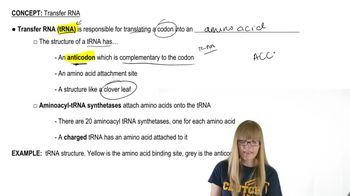
Describe three features of tRNA molecules that lead to their correct charging by tRNA synthetase enzymes.
A portion of a DNA template strand has the base sequence
5′-...ACGCGATGCGTGATGTATAGAGCT...-3′
Assume the mRNA is written in the correct reading frame. Determine the amino acid sequence encoded by this fragment. Identify the N- and C-terminal directions of the polypeptide.
A couple and some of their relatives are screened for Gaucher disease in a community-based screening program. The woman is homozygous for the dominant allele, represented by G. The woman's father, sister, and paternal grandmother are heterozygous carriers of the mutant allele, represented by g. Her paternal grandfather, her mother, and both of her mother's parents are homozygous for the dominant allele. The man is heterozygous and he has a brother with Gaucher disease. The man's parents and grandparents have not been tested, but it is known that none of them has Gaucher disease.
Explain why you are able to assign genotypes to the man's parents despite their not being tested.
A couple and some of their relatives are screened for Gaucher disease in a community-based screening program. The woman is homozygous for the dominant allele, represented by G. The woman's father, sister, and paternal grandmother are heterozygous carriers of the mutant allele, represented by g. Her paternal grandfather, her mother, and both of her mother's parents are homozygous for the dominant allele. The man is heterozygous and he has a brother with Gaucher disease. The man's parents and grandparents have not been tested, but it is known that none of them has Gaucher disease.
Draw a pedigree of this family, including the woman, the man, their siblings, parents, and grandparents.
A portion of a DNA template strand has the base sequence
5′-...ACGCGATGCGTGATGTATAGAGCT...-3′
Identify the sequence and polarity of the mRNA transcribed from this fragmentary template-strand sequence.