Several lines of experimental evidence pointed to a triplet genetic code. Identify three pieces of information that supported the triplet hypothesis of genetic code structure.
Ch. 9 - The Molecular Biology of Translation

Sanders3rd EditionGenetic Analysis: An Integrated ApproachISBN: 9780135564172Not the one you use?Change textbook
Chapter 9, Problem 5b
A portion of a DNA template strand has the base sequence
5′-...ACGCGATGCGTGATGTATAGAGCT...-3′
Assume the mRNA is written in the correct reading frame. Determine the amino acid sequence encoded by this fragment. Identify the N- and C-terminal directions of the polypeptide.
Verified step by step guidance1
Step 1: Identify the complementary mRNA sequence by transcribing the DNA template strand. Remember that RNA uses uracil (U) instead of thymine (T). The DNA template strand is read in the 3′ to 5′ direction, so the mRNA will be synthesized in the 5′ to 3′ direction. For example, A pairs with U, C pairs with G, G pairs with C, and T pairs with A.
Step 2: Divide the mRNA sequence into codons (groups of three nucleotides). Each codon corresponds to a specific amino acid or a stop signal during translation.
Step 3: Use the genetic code table to translate each codon into its corresponding amino acid. For example, AUG codes for methionine (start codon), and UAA, UAG, or UGA are stop codons.
Step 4: Determine the directionality of the polypeptide chain. Translation begins at the N-terminal (amino group) and proceeds toward the C-terminal (carboxyl group). The first amino acid corresponds to the start codon, and the sequence ends at the stop codon.
Step 5: Write out the amino acid sequence in order, starting from the N-terminal and ending at the C-terminal. Ensure that you include the start codon and stop translation at the stop codon.

Verified video answer for a similar problem:
This video solution was recommended by our tutors as helpful for the problem above.
Video duration:
2mWas this helpful?
Key Concepts
Here are the essential concepts you must grasp in order to answer the question correctly.
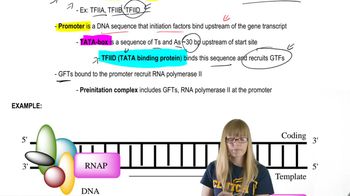
Transcription
Transcription is the process by which the genetic information in DNA is copied into messenger RNA (mRNA). During this process, RNA polymerase binds to the DNA template strand and synthesizes a complementary RNA strand, replacing thymine (T) with uracil (U). Understanding transcription is essential for determining how the DNA sequence translates into an mRNA sequence, which is the first step in protein synthesis.
Recommended video:
Guided course
Eukaryotic Transcription
Translation
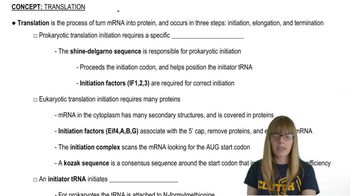
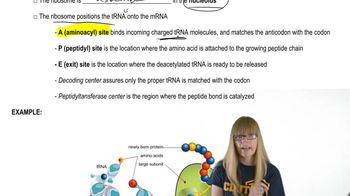
Translation is the process by which the mRNA sequence is decoded to synthesize a polypeptide chain, which will fold into a functional protein. This occurs in the ribosome, where transfer RNA (tRNA) molecules bring specific amino acids to the growing polypeptide chain based on the codon sequence of the mRNA. Recognizing how codons correspond to amino acids is crucial for determining the final amino acid sequence from the mRNA.
Recommended video:
Guided course
Translation initiation
Amino Acid Structure and Polypeptide Directionality
Amino acids are the building blocks of proteins, each consisting of a central carbon atom, an amino group, a carboxyl group, and a variable R group that determines the specific properties of the amino acid. In a polypeptide chain, the N-terminus refers to the end with a free amino group, while the C-terminus has a free carboxyl group. Understanding this directionality is important for correctly identifying the ends of the synthesized polypeptide and its functional implications.
Recommended video:
Guided course
Ribosome Structure
Related Practice
Textbook Question
506
views
Textbook Question
Outline the events that occur during initiation of translation in E. coli.
609
views
Textbook Question
A portion of a DNA template strand has the base sequence
5′-...ACGCGATGCGTGATGTATAGAGCT...-3′
Identify the sequence and polarity of the mRNA transcribed from this fragmentary template-strand sequence.
773
views
Textbook Question
A portion of a DNA template strand has the base sequence
5′-...ACGCGATGCGTGATGTATAGAGCT...-3′
Which is the third amino acid added to the polypeptide chain?
639
views
Textbook Question
Describe three features of tRNA molecules that lead to their correct charging by tRNA synthetase enzymes.
1195
views
Textbook Question
Identify the amino acid carried by tRNAs with the following anticodon sequences.
5′-UAG-3′
396
views