Pearson+ LogoPearson+ Logo
Ch. 9 - The Molecular Biology of Translation
Sanders - Genetic Analysis: An Integrated Approach 3rd Edition
Sanders3rd EditionGenetic Analysis: An Integrated ApproachISBN: 9780135564172Not the one you use?Change textbook
Chapter 9, Problem 29b

Explain why it is not feasible to insert the entire human insulin gene into E. coli and anticipate the production of insulin.

Verified step by step guidance
1
Understand that the human insulin gene contains both exons (coding regions) and introns (non-coding regions). In humans, the gene is transcribed into pre-mRNA, which then undergoes splicing to remove introns, producing mature mRNA.
Recognize that E. coli, being a prokaryote, lacks the cellular machinery to perform RNA splicing. Therefore, if the entire human insulin gene (including introns) is inserted into E. coli, the bacterium cannot correctly process the gene to produce functional mRNA.
Note that without proper mRNA processing, the translation machinery in E. coli will produce a nonfunctional or truncated protein because the introns will be translated as well, disrupting the insulin protein sequence.
Conclude that to produce insulin in E. coli, scientists use complementary DNA (cDNA) synthesized from mature mRNA, which contains only the exons, ensuring that the bacterial system can translate the gene correctly into functional insulin protein.
Summarize that the key issue is the presence of introns in the human insulin gene and the inability of E. coli to process these introns, making direct insertion of the entire gene ineffective for insulin production.

Verified video answer for a similar problem:

This video solution was recommended by our tutors as helpful for the problem above.
Video duration:
1m
Was this helpful?

Key Concepts

Here are the essential concepts you must grasp in order to answer the question correctly.

Gene Structure in Eukaryotes vs. Prokaryotes

Eukaryotic genes, like the human insulin gene, contain introns (non-coding regions) that are removed during RNA processing. Prokaryotes such as E. coli lack the machinery to splice out introns, so inserting the entire gene including introns prevents proper protein synthesis.
Recommended video:
Guided course
07:10
Chromosome Structure

Use of cDNA for Gene Expression in Bacteria

To express eukaryotic proteins in bacteria, scientists use complementary DNA (cDNA) synthesized from mature mRNA, which lacks introns. This allows E. coli to transcribe and translate the gene correctly, producing functional insulin.
Recommended video:
Guided course
02:09
Penetrance and Expressivity

Post-Translational Modifications and Protein Folding

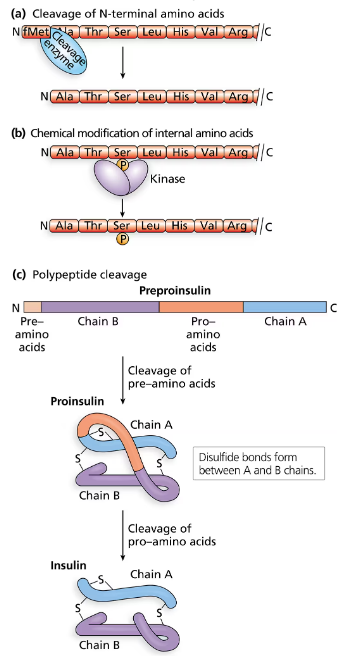
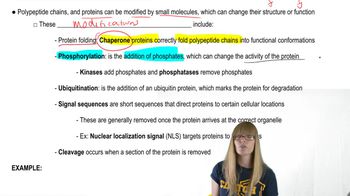
Human insulin requires specific folding and modifications to become active, processes that E. coli may not perform correctly. Even with the gene expressed, bacterial systems might produce inactive or misfolded insulin without additional engineering.
Recommended video:
Guided course
04:30
Post Translational Modifications
Related Practice
Textbook Question

The mature mRNA transcribed from the human β-globin gene is considerably longer than the sequence needed to encode the 146–amino acid polypeptide. Give the names of three sequences located on the mature β-globin mRNA but not translated.

660
views
Textbook Question

The following figure contains several examples of the Shine–Dalgarno sequence. Using the seven Shine–Dalgarno sequences from E. coli, determine the consensus sequence and describe its location relative to the start codon.

541
views
Textbook Question

A research scientist is interested in producing human insulin in the bacterial species E. coli. Will the genetic code allow the production of human proteins from bacterial cells? Explain why or why not.


598
views
Textbook Question

Recombinant human insulin (made by inserting human DNA encoding insulin into E. coli) is one of the most widely used recombinant pharmaceutical products in the world. What segments of the human insulin gene are used to create recombinant bacteria that produce human insulin?

567
views
Textbook Question

A DNA sequence encoding a five-amino acid polypeptide is given below.

...ACGGCAAGATCCCACCCTAATCAGACCGTACCATTCACCTCCT...

...TGCCGTTCTAGGGTGGGATTAGTCTGGCATGGTAAGTGGAGGA...

Locate the sequence encoding the five amino acids of the polypeptide, and identify the template and coding strands of DNA.

573
views
Textbook Question

A DNA sequence encoding a five-amino acid polypeptide is given below.

...ACGGCAAGATCCCACCCTAATCAGACCGTACCATTCACCTCCT...

...TGCCGTTCTAGGGTGGGATTAGTCTGGCATGGTAAGTGGAGGA...

Give the sequence and polarity of the mRNA encoding the polypeptide.

703
views