Pearson+ LogoPearson+ Logo
Ch. 9 - The Molecular Biology of Translation
Sanders - Genetic Analysis: An Integrated Approach 3rd Edition
Sanders3rd EditionGenetic Analysis: An Integrated ApproachISBN: 9780135564172Not the one you use?Change textbook
Chapter 9, Problem 27

The mature mRNA transcribed from the human β-globin gene is considerably longer than the sequence needed to encode the 146–amino acid polypeptide. Give the names of three sequences located on the mature β-globin mRNA but not translated.

Verified step by step guidance
1
Identify the components of a mature mRNA molecule that are not translated into protein.
Recall that mature mRNA consists of both coding and non-coding regions.
Understand that the coding region is the sequence that is translated into a polypeptide.
Recognize that the non-coding regions include the 5' untranslated region (5' UTR), the 3' untranslated region (3' UTR), and the poly-A tail.
List the three sequences on the mature β-globin mRNA that are not translated: the 5' UTR, the 3' UTR, and the poly-A tail.

Verified video answer for a similar problem:

This video solution was recommended by our tutors as helpful for the problem above.
Video duration:
1m
Was this helpful?

Key Concepts

Here are the essential concepts you must grasp in order to answer the question correctly.

mRNA Structure

Messenger RNA (mRNA) is a single-stranded molecule that carries genetic information from DNA to the ribosome for protein synthesis. It consists of coding sequences (exons) that are translated into proteins and non-coding sequences (introns and untranslated regions) that play regulatory roles. Understanding the structure of mRNA is essential for identifying which parts are translated and which are not.
Recommended video:
Guided course
03:49
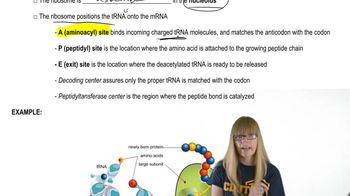
Ribosome Structure

Untranslated Regions (UTRs)

Untranslated regions (UTRs) are segments of mRNA that are not translated into protein. They are found at both the 5' and 3' ends of the mRNA molecule and are crucial for regulating translation efficiency, stability, and localization of the mRNA. The 5' UTR often contains regulatory elements that influence ribosome binding, while the 3' UTR can affect mRNA stability and degradation.
Recommended video:
Guided course
00:30
Regions of X Chromosomes

Post-Transcriptional Modifications

Post-transcriptional modifications are processes that occur after the initial transcription of mRNA from DNA. These modifications include the addition of a 5' cap, polyadenylation at the 3' end, and splicing to remove introns. These changes are vital for mRNA stability, transport out of the nucleus, and proper translation, and they help define the mature mRNA that is ultimately translated into protein.
Recommended video:
Guided course
04:30
Post Translational Modifications