
Textbook Question
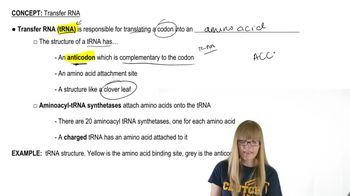
Identify the amino acid carried by tRNAs with the following anticodon sequences.
5′-GAU-3′
543
views

 Verified step by step guidance
 05:05
05:05
Identify the amino acid carried by tRNAs with the following anticodon sequences.
5′-GAU-3′
Identify the amino acid carried by tRNAs with the following anticodon sequences.
5′-UAG-3′
For each of the anticodon sequences given in the previous problem, identify the other codon sequence to which it could potentially pair using third base wobble.
A couple and some of their relatives are screened for Gaucher disease in a community-based screening program. The woman is homozygous for the dominant allele, represented by G. The woman's father, sister, and paternal grandmother are heterozygous carriers of the mutant allele, represented by g. Her paternal grandfather, her mother, and both of her mother's parents are homozygous for the dominant allele. The man is heterozygous and he has a brother with Gaucher disease. The man's parents and grandparents have not been tested, but it is known that none of them has Gaucher disease.
On the pedigree, write the genotypes (GG, Gg, or gg) for each person who has been tested or for whom you can deduce a genotype. If a genotype cannot be determined completely, list the alleles you know or deduce must be present.
Identify the amino acid carried by tRNAs with the following anticodon sequences.
5′-AAA-3′
Identify the amino acid carried by tRNAs with the following anticodon sequences.
5′-AUG-3′