Pearson+ LogoPearson+ Logo
Ch. 9 - The Molecular Biology of Translation
Sanders - Genetic Analysis: An Integrated Approach 3rd Edition
Sanders3rd EditionGenetic Analysis: An Integrated ApproachISBN: 9780135564172Not the one you use?Change textbook
Chapter 9, Problem 15a

The three major forms of RNA (mRNA, tRNA, and rRNA) interact during translation.
Describe the role each form of RNA performs during translation.

Verified step by step guidance
1
Understand that translation is the process by which the genetic code in mRNA is used to synthesize a protein. This process occurs in the ribosome and involves three major forms of RNA: mRNA, tRNA, and rRNA.
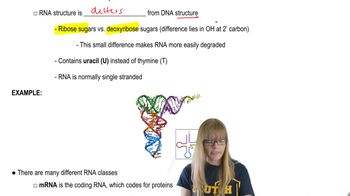
mRNA (messenger RNA) serves as the template for translation. It carries the genetic code from DNA in the form of codons, which are sequences of three nucleotides that specify particular amino acids.
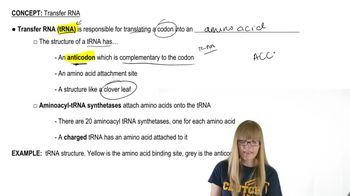
tRNA (transfer RNA) acts as the adapter molecule. Each tRNA has an anticodon region that pairs with a complementary codon on the mRNA and a specific amino acid attachment site. This ensures that the correct amino acid is added to the growing polypeptide chain.
rRNA (ribosomal RNA) is a structural and functional component of the ribosome. It helps catalyze the formation of peptide bonds between amino acids and ensures proper alignment of the mRNA and tRNA during translation.
Combine the roles: mRNA provides the instructions, tRNA brings the correct amino acids, and rRNA facilitates the assembly of the protein. Together, these RNAs coordinate to translate the genetic code into a functional protein.

Verified video answer for a similar problem:

This video solution was recommended by our tutors as helpful for the problem above.
Video duration:
2m
Was this helpful?

Key Concepts

Here are the essential concepts you must grasp in order to answer the question correctly.

mRNA (messenger RNA)

mRNA is a type of RNA that carries genetic information from DNA to the ribosome, where proteins are synthesized. It is transcribed from a gene and serves as a template for the sequence of amino acids in a protein. During translation, the ribosome reads the mRNA sequence in sets of three nucleotides, known as codons, to assemble the corresponding amino acids.
Recommended video:

tRNA (transfer RNA)

tRNA is responsible for bringing the appropriate amino acids to the ribosome during translation. Each tRNA molecule has an anticodon that is complementary to a specific mRNA codon, ensuring that the correct amino acid is added to the growing polypeptide chain. This process is crucial for accurately translating the genetic code into functional proteins.
Recommended video:

rRNA (ribosomal RNA)

rRNA is a structural and functional component of ribosomes, the cellular machinery that facilitates protein synthesis. It helps to stabilize the binding of mRNA and tRNA during translation and catalyzes the formation of peptide bonds between amino acids. rRNA plays a critical role in ensuring the efficiency and accuracy of the translation process.
Recommended video:
Related Practice
Textbook Question

Third-base wobble allows some tRNAs to recognize more than one mRNA codon. Based on this chapter's discussion of wobble, what is the minimal number of tRNA molecules necessary to recognize the following amino acids?

Isoleucine

796
views
Textbook Question

Third-base wobble allows some tRNAs to recognize more than one mRNA codon. Based on this chapter's discussion of wobble, what is the minimal number of tRNA molecules necessary to recognize the following amino acids?

Lysine

718
views
Textbook Question

The genetic code contains 61 codons to specify the 20 common amino acids. Many organisms carry fewer than 61 different tRNA genes in their genomes. These genomes take advantage of isoaccepting tRNAs and the rules governing third-base wobble to encode fewer than 61 tRNA genes. Use these rules to calculate the minimal number of tRNA genes required to specify all 20 of the common amino acids.

742
views
Textbook Question

The three major forms of RNA (mRNA, tRNA, and rRNA) interact during translation.

Which of the three types of RNA might you expect to be the least stable? Why?

1013
views
Textbook Question

The three major forms of RNA (mRNA, tRNA, and rRNA) interact during translation.

Which form of RNA is least stable in eukaryotes? Why is this form least stable?

953
views
Textbook Question

The three major forms of RNA (mRNA, tRNA, and rRNA) interact during translation.

Compared to the average stability of mRNA in E. coli, is mRNA in a typical human cell more stable or less stable? Why?

831
views