Pearson+ LogoPearson+ Logo
Ch.10 Proteins Workers of the Cell
Frost - General, Organic and Biological Chemistry 4th Edition
Frost4th EditionGeneral, Organic and Biological ChemistryISBN: 9780134988696Not the one you use?Change textbook
Chapter 6, Problem 37

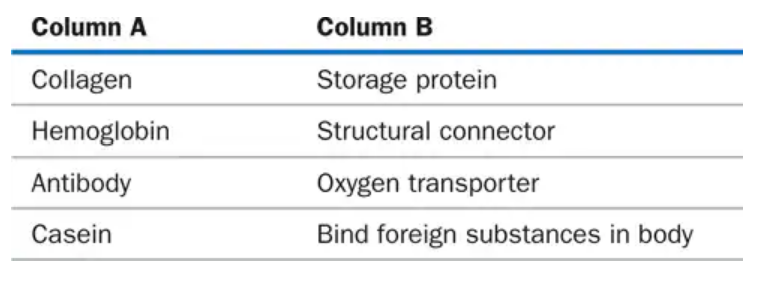
Match each protein in column A with its function in column B:
Table matching proteins in Column A with their functions in Column B, including collagen, hemoglobin, antibody, and casein.

Verified step by step guidance
1
Identify the proteins listed in column A and their corresponding descriptions or functions in column B.
Review the general functions of proteins, such as structural support, enzymatic activity, transport, signaling, and immune response, to understand the context of the matching process.
For each protein in column A, analyze its name or any associated keywords to determine its specific role or function. For example, hemoglobin is associated with oxygen transport, and enzymes like amylase are linked to catalyzing reactions.
Match each protein in column A to the most appropriate function in column B based on your understanding of their roles in biological systems.
Double-check your matches to ensure that each protein is paired with the correct function, and there are no mismatches or ambiguities in your answers.

Verified video answer for a similar problem:

This video solution was recommended by our tutors as helpful for the problem above.
Video duration:
4m
Was this helpful?

Key Concepts

Here are the essential concepts you must grasp in order to answer the question correctly.

Protein Structure

Proteins are composed of long chains of amino acids that fold into specific three-dimensional shapes. The structure of a protein is crucial because it determines its function. There are four levels of protein structure: primary, secondary, tertiary, and quaternary, each contributing to the overall shape and functionality of the protein.
Recommended video:
Guided course
3:26
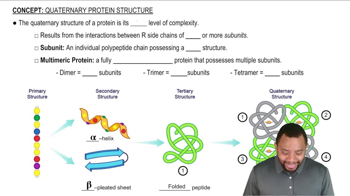
Quaternary Protein Structure Concept 1

Enzyme Function

Many proteins act as enzymes, which are biological catalysts that speed up chemical reactions in the body. Enzymes have specific active sites that bind to substrates, facilitating the conversion of reactants into products. Understanding the role of enzymes is essential for matching proteins to their functions, as each enzyme is tailored to a particular reaction.
Recommended video:
Guided course
02:16
Logarithmic Functions

Protein-Function Relationship

The relationship between a protein's structure and its function is fundamental in biochemistry. Each protein's unique sequence of amino acids and its resulting shape enable it to perform specific tasks, such as transport, signaling, or structural support. Recognizing this relationship is key to accurately matching proteins with their respective functions.
Recommended video:
Guided course
04:56
Logarithmic Relationships