Pearson+ LogoPearson+ Logo
Ch.11 Nucleic Acids Big Molecules with a Big Role
Frost - General, Organic and Biological Chemistry 4th Edition
Frost4th EditionGeneral, Organic and Biological ChemistryISBN: 9780134988696Not the one you use?Change textbook
Chapter 7, Problem 75c

What is the anticodon on tRNA for each of the following codons in an mRNA?
c. GAA

Verified step by step guidance
1
Understand the relationship between codons in mRNA and anticodons in tRNA. Codons are sequences of three nucleotides in mRNA that specify amino acids, while anticodons are complementary sequences of three nucleotides in tRNA that pair with the codons during translation.
Identify the given mRNA codon: GAA. This is the sequence that we need to find the complementary anticodon for.
Recall the base-pairing rules for RNA: Adenine (A) pairs with Uracil (U), Cytosine (C) pairs with Guanine (G), and Guanine (G) pairs with Cytosine (C).
Apply the base-pairing rules to determine the anticodon sequence. For the mRNA codon GAA, the complementary anticodon will be formed by pairing each nucleotide: G pairs with C, A pairs with U, and A pairs with U.
Write the anticodon sequence in the 5' to 3' direction, as tRNA anticodons are conventionally written in this orientation. Ensure the sequence is correctly derived based on the base-pairing rules.

Verified video answer for a similar problem:

This video solution was recommended by our tutors as helpful for the problem above.
Video duration:
41s
Was this helpful?

Key Concepts

Here are the essential concepts you must grasp in order to answer the question correctly.

Codons and Anticodons

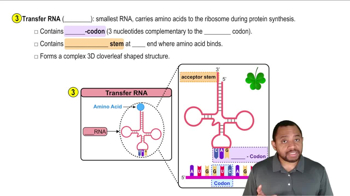
Codons are sequences of three nucleotides in mRNA that specify a particular amino acid during protein synthesis. Each codon corresponds to a specific anticodon on tRNA, which is a complementary sequence of three nucleotides. This pairing is crucial for the accurate translation of genetic information into proteins.
Recommended video:
Guided course
2:23
Types of RNA Concept 2

Base Pairing Rules

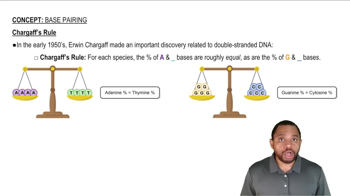
Base pairing rules dictate how nucleotides pair with each other in DNA and RNA. In RNA, adenine (A) pairs with uracil (U), and cytosine (C) pairs with guanine (G). Understanding these rules is essential for determining the correct anticodon that pairs with a given mRNA codon.
Recommended video:
Guided course
2:01
Base Pairing Concept 2

tRNA Function

Transfer RNA (tRNA) plays a critical role in translating mRNA into proteins by bringing the appropriate amino acids to the ribosome. Each tRNA molecule has a specific anticodon that matches a codon on the mRNA, ensuring that the correct amino acid is added to the growing polypeptide chain during translation.
Recommended video:
Guided course
02:16
Logarithmic Functions