Ch.14 Some Compounds with Oxygen, Sulfur, or a Halogen
McMurry - Fundamentals of General, Organic, and Biological Chemistry 8th Edition
McMurry8th EditionFundamentals of General, Organic, and Biological ChemistryISBN: 9780134015187Not the one you use?Change textbook
Chapter 14, Problem 58a

Identify the chiral center(s) in each of the following molecules:
a. 2-Methyl-3-pentanol

Verified video answer for a similar problem:

This video solution was recommended by our tutors as helpful for the problem above.
Video duration:
1m
Was this helpful?

Key Concepts

Here are the essential concepts you must grasp in order to answer the question correctly.

Chirality

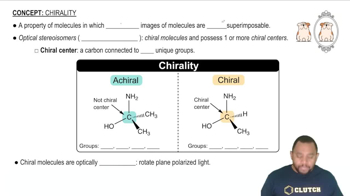
Chirality refers to the geometric property of a molecule that makes it non-superimposable on its mirror image. A chiral molecule typically has at least one chiral center, which is usually a carbon atom bonded to four different substituents. This property is crucial in many fields, including pharmaceuticals, as different enantiomers can have vastly different biological effects.
Recommended video:
Guided course
1:39
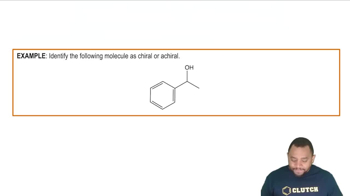
Chirality Example 1

Chiral Center

A chiral center, often a carbon atom, is defined as a carbon that is bonded to four distinct groups or atoms. The presence of a chiral center in a molecule indicates that the molecule can exist in two enantiomeric forms, which are mirror images of each other. Identifying chiral centers is essential for understanding the stereochemistry of organic compounds.
Recommended video:
Guided course
2:37
Chirality Concept 1

Stereochemistry

Stereochemistry is the branch of chemistry that deals with the spatial arrangement of atoms in molecules and the impact of this arrangement on their chemical properties and reactions. It encompasses concepts such as chirality, enantiomers, and diastereomers, which are vital for predicting how molecules interact in biological systems and chemical reactions.
Recommended video:
Guided course
1:30
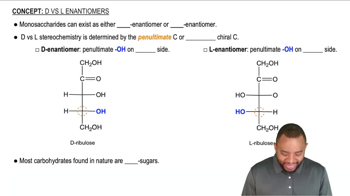
D vs L Enantiomers Concept 1