

Pearson+ LogoPearson+ Logo
Ch.7 Chemical Reactions: Energy, Rate and Equilibrium
McMurry - Fundamentals of GOB 8th Edition
McMurry8th EditionFundamentals of GOBISBN: 9780134015187Not the one you use?Change textbook
Chapter 7, Problem 7a

Does entropy increase or decrease in the following processes?
a. Polymeric complex carbohydrates are metabolized by the body, converted into smaller simple sugars.

Verified step by step guidance
1
Understand the concept of entropy: Entropy is a measure of the disorder or randomness in a system. Processes that increase disorder typically result in an increase in entropy, while processes that lead to more order result in a decrease in entropy.
Analyze the process described: The problem states that polymeric complex carbohydrates (large, organized molecules) are metabolized and broken down into smaller, simpler sugars. This involves breaking chemical bonds and producing smaller, more disordered molecules.
Relate the process to entropy: Breaking down a large, organized molecule into smaller, less organized molecules increases the randomness or disorder of the system. This suggests that the entropy of the system increases during this process.
Consider the surroundings: In biological systems, the breakdown of complex carbohydrates is often coupled with energy release. While the system's entropy increases, the overall entropy of the universe (system + surroundings) also increases due to the release of heat.
Conclude the analysis: Based on the breakdown of large molecules into smaller ones and the increase in disorder, the entropy of the system increases during the metabolism of polymeric complex carbohydrates into simple sugars.

Verified video answer for a similar problem:

This video solution was recommended by our tutors as helpful for the problem above.
Video duration:
1m
Was this helpful?

Key Concepts

Here are the essential concepts you must grasp in order to answer the question correctly.

Entropy

Entropy is a measure of the disorder or randomness in a system. In thermodynamics, it is often associated with the second law, which states that the total entropy of an isolated system can never decrease over time. This concept is crucial for understanding how energy transformations occur and how they affect the state of matter.
Recommended video:
Guided course
00:54
Entropy (Simplified) Concept 1

Metabolism

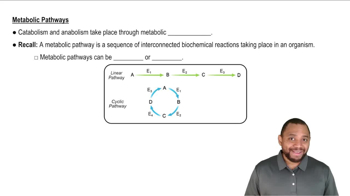
Metabolism refers to the biochemical processes that occur within living organisms to maintain life. It includes catabolic reactions, which break down complex molecules into simpler ones, releasing energy, and anabolic reactions, which build complex molecules from simpler ones. Understanding metabolism is essential for analyzing how the body processes nutrients and the associated changes in entropy.
Recommended video:
Guided course
0:52
Metabolic Pathways Concept 2

Complex Carbohydrates

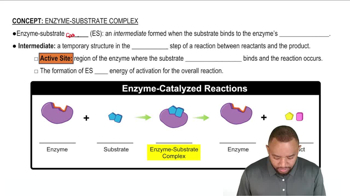
Complex carbohydrates are large molecules made up of long chains of sugar units, which the body breaks down into simpler sugars during digestion. This process involves hydrolysis, where water is used to break the bonds between sugar units. The breakdown of these complex carbohydrates typically leads to an increase in entropy, as the system transitions from a more ordered state to a more disordered one.
Recommended video:
Guided course
2:32
Enzyme-Substrate Complex Concept 1