Pearson+ LogoPearson+ Logo
Ch.4 Molecular Compounds
McMurry - Fundamentals of GOB 8th Edition
McMurry8th EditionFundamentals of GOBISBN: 9780134015187Not the one you use?Change textbook
Chapter 4, Problem 49a

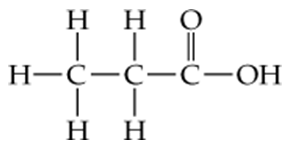
Consider the following possible structural formulas for C3H6O2. If a structure is not reasonable, explain what changes could be made to convert it to a reasonable structure.
a.

Verified step by step guidance
1
Step 1: Analyze the molecular formula C₃H₆O₂ and verify that it corresponds to a molecule with 3 carbon atoms, 6 hydrogen atoms, and 2 oxygen atoms. This formula suggests the possibility of functional groups such as carboxylic acids, esters, or alcohols.
Step 2: Examine the provided structure. Count the number of carbon, hydrogen, and oxygen atoms to ensure it matches the molecular formula. In this case, the structure contains 6 carbon atoms, which exceeds the molecular formula C₃H₆O₂. This indicates the structure is not reasonable.
Step 3: Identify the issue with the structure. The molecular formula C₃H₆O₂ requires only 3 carbon atoms, but the provided structure has additional carbons. To make the structure reasonable, remove the extra carbon atoms while maintaining the correct number of hydrogens and oxygens.
Step 4: Consider possible functional groups that fit the molecular formula. For example, a carboxylic acid group (-COOH) or an ester group (-COOR) could be included. Adjust the structure to incorporate these groups while ensuring the total number of atoms matches the molecular formula.
Step 5: Verify the revised structure by checking the valency of each atom. Carbon should form 4 bonds, oxygen should form 2 bonds, and hydrogen should form 1 bond. Ensure the revised structure adheres to these rules and matches the molecular formula C₃H₆O₂.

Verified video answer for a similar problem:

This video solution was recommended by our tutors as helpful for the problem above.
Video duration:
4m
Was this helpful?

Key Concepts

Here are the essential concepts you must grasp in order to answer the question correctly.

Molecular Formula and Structure

The molecular formula C₃H₆O₂ indicates that the compound consists of three carbon (C) atoms, six hydrogen (H) atoms, and two oxygen (O) atoms. Understanding how these atoms can be arranged in various structural forms is crucial for determining the validity of a proposed structure. Each atom's valency must be satisfied, and the overall structure must adhere to the rules of chemical bonding.
Recommended video:
Guided course
02:08
Molecular Formula

Lewis Structures

Lewis structures are diagrams that represent the bonding between atoms in a molecule and the lone pairs of electrons that may exist. They help visualize how atoms are connected and the distribution of electrons. For C₃H₆O₂, a correct Lewis structure must show all atoms bonded appropriately, with the correct number of bonds and lone pairs, ensuring that each atom achieves a stable electron configuration.
Recommended video:
Guided course
03:11
Lewis Dot Structures: Ions (Simplified) Concept 1

Functional Groups

Functional groups are specific groups of atoms within molecules that are responsible for the characteristic chemical reactions of those molecules. In the case of C₃H₆O₂, common functional groups include carboxylic acids and esters. Identifying these groups is essential for understanding the reactivity and properties of the compound, as well as for determining if a proposed structure is reasonable based on the presence of these groups.
Recommended video:
Guided course
1:11
Functional Group Priorities Concept 1