Pearson+ LogoPearson+ Logo
Ch.26 Nucleic Acids and Protein Synthesis
McMurry - Fundamentals of GOB 8th Edition
McMurry8th EditionFundamentals of GOBISBN: 9780134015187Not the one you use?Change textbook
Chapter 26, Problem 41

Draw the complete structure of the RNA dinucleotide U-C. Identify the 5′ and 3′ ends of the dinucleotide.

Verified step by step guidance
1
Understand that RNA is composed of nucleotides, each consisting of a ribose sugar, a phosphate group, and a nitrogenous base. In this case, the bases are uracil (U) and cytosine (C).
Start by drawing the ribose sugar for the first nucleotide (U). Label the carbon atoms on the ribose as 1′, 2′, 3′, 4′, and 5′. Attach a phosphate group to the 5′ carbon and the uracil base to the 1′ carbon.
Draw the ribose sugar for the second nucleotide (C). Similarly, label the carbon atoms and attach a phosphate group to the 5′ carbon and the cytosine base to the 1′ carbon.
Connect the two nucleotides by forming a phosphodiester bond between the 3′ hydroxyl group (-OH) of the first nucleotide (U) and the phosphate group attached to the 5′ carbon of the second nucleotide (C).
Label the 5′ end of the dinucleotide (where the free phosphate group is attached) and the 3′ end (where the free hydroxyl group is located) to clearly identify the directionality of the RNA strand.

Verified video answer for a similar problem:

This video solution was recommended by our tutors as helpful for the problem above.
Video duration:
1m
Was this helpful?

Key Concepts

Here are the essential concepts you must grasp in order to answer the question correctly.

RNA Structure

RNA, or ribonucleic acid, is a single-stranded molecule composed of nucleotides, each containing a ribose sugar, a phosphate group, and a nitrogenous base. The sequence of these nucleotides determines the RNA's function, which can include coding for proteins, catalyzing reactions, or regulating gene expression. Understanding the basic structure of RNA is essential for drawing and identifying its components.
Recommended video:
Guided course
2:43
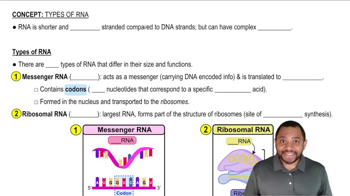
Types of RNA Concept 1

Nucleotide Composition

A dinucleotide consists of two nucleotides linked by a phosphodiester bond. In the case of the dinucleotide U-C, the first nucleotide is uridine (U) and the second is cytidine (C). Each nucleotide has a specific orientation, with a 5′ phosphate group and a 3′ hydroxyl group, which are crucial for understanding the directionality of the RNA strand.
Recommended video:
Guided course
1:21
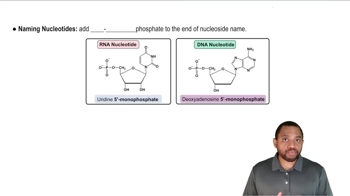
Naming Nucleosides and Nucleotides Concept 2

5′ and 3′ Ends

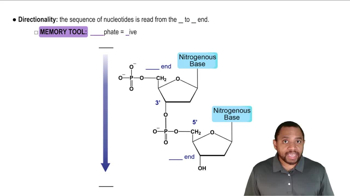
The 5′ and 3′ ends of an RNA molecule refer to the orientation of the sugar-phosphate backbone. The 5′ end has a free phosphate group, while the 3′ end has a free hydroxyl group. This directional notation is important for understanding RNA synthesis and function, as it influences how RNA interacts with other molecules and how it is read during translation.
Recommended video:
Guided course
1:43
Primary Structure of Nucleic Acids Concept 2