Pearson+ LogoPearson+ Logo
Ch.17 Carboxylic Acids and Their Derivatives
McMurry - Fundamentals of GOB 8th Edition
McMurry8th EditionFundamentals of GOBISBN: 9780134015187Not the one you use?Change textbook
Chapter 17, Problem 8a

Write both condensed and line structures for (a) the ester formed when butyric acid reacts with cyclopentanol.

Verified step by step guidance
1
Step 1: Understand the reaction types. (a) An ester is formed when a carboxylic acid reacts with an alcohol. (b) and (c) Amides are formed when a carboxylic acid reacts with an amine. In each case, the reaction involves the removal of water (a condensation reaction).
Step 2: For part (a), identify the reactants: butyric acid (C3H7COOH) and cyclopentanol (C5H10OH). The ester is formed by replacing the -OH group of the carboxylic acid with the -O- group from the alcohol. Write the condensed structure of the ester and draw the line structure by connecting the cyclopentyl group to the carbonyl carbon of butyric acid.
Step 3: For part (b), identify the reactants: butyric acid (C3H7COOH) and isopropyl amine ((CH3)2CHNH2). The amide is formed by replacing the -OH group of the carboxylic acid with the -NH- group from the amine. Write the condensed structure of the amide and draw the line structure by connecting the isopropyl group to the carbonyl carbon of butyric acid.
Step 4: For part (c), identify the reactants: butyric acid (C3H7COOH) and diethylamine ((C2H5)2NH). The amide is formed by replacing the -OH group of the carboxylic acid with the -N- group from the amine. Write the condensed structure of the amide and draw the line structure by connecting the diethyl group to the carbonyl carbon of butyric acid.
Step 5: For part (d), name the derivatives. (a) The ester is named as an alkyl alkanoate, where the alkyl group comes from the alcohol and the alkanoate comes from the carboxylic acid. (b) and (c) The amides are named as N-substituted alkylamides, where the substituents on the nitrogen are listed, followed by the name of the amide derived from the carboxylic acid.

Verified video answer for a similar problem:

This video solution was recommended by our tutors as helpful for the problem above.
Was this helpful?

Key Concepts

Here are the essential concepts you must grasp in order to answer the question correctly.

Esterification

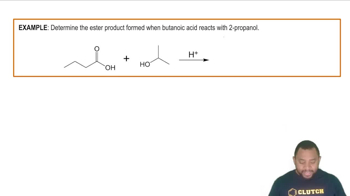
Esterification is a chemical reaction between an alcohol and a carboxylic acid, resulting in the formation of an ester and water. In this process, the hydroxyl group (-OH) from the acid and a hydrogen atom from the alcohol combine to release water, while the remaining parts form the ester. Understanding this reaction is crucial for predicting the structure of the ester formed from butyric acid and cyclopentanol.
Recommended video:
Guided course
0:46
Ester Reactions: Esterification Example 1

Amide Formation

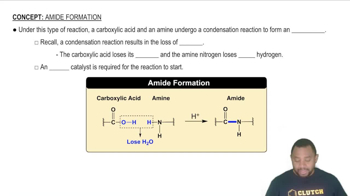
Amide formation occurs when a carboxylic acid reacts with an amine, resulting in the production of an amide and water. This reaction involves the replacement of the hydroxyl group of the acid with the amine's nitrogen group. Recognizing this mechanism is essential for determining the structures of the amides formed from butyric acid with isopropyl amine and diethylamine.
Recommended video:
Guided course
1:41
Amide Formation Concept 1

Nomenclature of Organic Compounds

Nomenclature in organic chemistry refers to the systematic naming of chemical compounds based on their structure and functional groups. The International Union of Pure and Applied Chemistry (IUPAC) provides rules for naming esters, amides, and other derivatives, which helps in identifying the compounds created in the reactions. Familiarity with these naming conventions is necessary for accurately naming the derivatives formed in parts (a)–(c).
Recommended video:
Guided course
2:26
Introduction to Organic Chemistry Concept 1