Pearson+ LogoPearson+ Logo
Ch.4 Introduction to Organic Compounds
Frost - General, Organic and Biological Chemistry 4th Edition
Frost4th EditionGeneral, Organic and Biological ChemistryISBN: 9780134988696Not the one you use?Change textbook
Chapter 1, Problem 67

How many structural isomers are possible for the molecular formula C5H11F? Draw the skeletal structure and give the IUPAC name of each compound.

Verified step by step guidance
1
Identify the number of carbon atoms in the molecular formula C_5H_11F, which is 5.
Consider the possible carbon chain arrangements (linear and branched) for 5 carbon atoms.
For each carbon chain arrangement, determine the possible positions for the fluorine atom.
Draw the skeletal structure for each unique arrangement of carbon atoms and fluorine position.
Assign the IUPAC name to each structural isomer based on the longest carbon chain and the position of the fluorine atom.

Verified video answer for a similar problem:

This video solution was recommended by our tutors as helpful for the problem above.
Video duration:
4m
Was this helpful?

Key Concepts

Here are the essential concepts you must grasp in order to answer the question correctly.

Structural Isomers

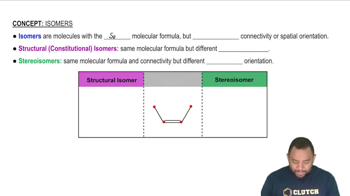
Structural isomers are compounds that have the same molecular formula but differ in the arrangement of atoms. This can include variations in the connectivity of the carbon skeleton or the position of functional groups. Understanding structural isomers is crucial for determining the different compounds that can be formed from a given molecular formula, such as C5H11F.
Recommended video:
Guided course
2:16
Isomers Concept 1

Skeletal Structure

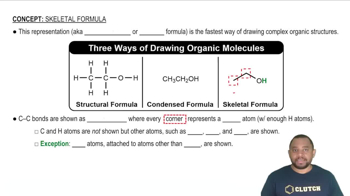
A skeletal structure is a simplified representation of a molecule that shows the arrangement of atoms and bonds without depicting all the hydrogen atoms explicitly. In skeletal structures, carbon atoms are represented by vertices or ends of lines, while other atoms, such as fluorine in this case, are shown explicitly. This method is commonly used in organic chemistry to visualize complex molecules more easily.
Recommended video:
Guided course
2:26
Skeletal Formula Concept 1

IUPAC Naming

IUPAC naming refers to the systematic method of naming chemical compounds established by the International Union of Pure and Applied Chemistry. It provides a standardized way to convey the structure of a compound through its name, which includes information about the number of carbon atoms, the presence of functional groups, and the type of bonds. Mastery of IUPAC naming is essential for accurately identifying and communicating about chemical substances.
Recommended video:
Guided course
3:18
IUPAC Naming Concept 3