Pearson+ LogoPearson+ Logo
Ch.10 Proteins Workers of the Cell
Frost - General, Organic and Biological Chemistry 4th Edition
Frost4th EditionGeneral, Organic and Biological ChemistryISBN: 9780134988696Not the one you use?Change textbook
Chapter 6, Problem 65b

Consider the amino acids glycine, proline, and lysine.
b. Using three-letter abbreviations for the amino acids, give the sequence for each of the possible tripeptides.

Verified step by step guidance
1
Identify the three amino acids given in the problem: glycine (Gly), proline (Pro), and lysine (Lys). These are the building blocks for the tripeptides.
Understand that a tripeptide is a sequence of three amino acids linked together by peptide bonds. The order of the amino acids in the sequence matters, so each unique arrangement represents a different tripeptide.
Determine the total number of possible sequences. Since there are three amino acids and each position in the tripeptide can be occupied by any of the three amino acids, the number of permutations is calculated as 3! (3 factorial), which equals 6.
List all possible sequences using the three-letter abbreviations for the amino acids. The sequences are: Gly-Pro-Lys, Gly-Lys-Pro, Pro-Gly-Lys, Pro-Lys-Gly, Lys-Gly-Pro, and Lys-Pro-Gly.
Verify that all six sequences are unique and that no sequence is repeated. This ensures that all possible tripeptides have been accounted for.

Verified video answer for a similar problem:

This video solution was recommended by our tutors as helpful for the problem above.
Video duration:
59s
Was this helpful?

Key Concepts

Here are the essential concepts you must grasp in order to answer the question correctly.

Amino Acids

Amino acids are organic compounds that serve as the building blocks of proteins. Each amino acid has a specific structure, consisting of a central carbon atom, an amino group, a carboxyl group, a hydrogen atom, and a variable side chain (R group) that determines its properties. Glycine (Gly), proline (Pro), and lysine (Lys) are three distinct amino acids, each with unique characteristics that influence protein structure and function.
Recommended video:
Guided course
3:03
Amino Acid Catabolism: Amino Group Example 2

Tripeptides

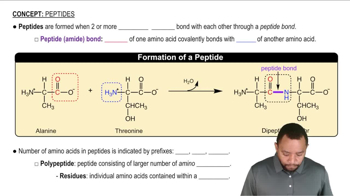
Tripeptides are molecules formed by the linkage of three amino acids through peptide bonds. The sequence in which the amino acids are arranged is crucial, as it determines the tripeptide's properties and biological function. The order of amino acids can vary, leading to different tripeptides even if the same amino acids are used, highlighting the importance of sequence in protein chemistry.
Recommended video:
Guided course
3:07
Peptides Concept 1

Three-Letter Abbreviations

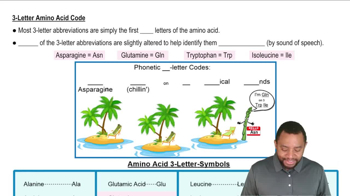
Three-letter abbreviations are standardized codes used to represent amino acids in a concise manner. For example, glycine is abbreviated as 'Gly', proline as 'Pro', and lysine as 'Lys'. These abbreviations facilitate easier communication and notation in biochemistry, especially when discussing sequences of amino acids in proteins or peptides.
Recommended video:
Guided course
2:18
Amino Acid Three Letter Codes Concept 2