Pearson+ LogoPearson+ Logo
Ch.11 Nucleic Acids Big Molecules with a Big Role
Frost - General, Organic and Biological Chemistry 4th Edition
Frost4th EditionGeneral, Organic and Biological ChemistryISBN: 9780134988696Not the one you use?Change textbook
Chapter 7, Problem 65b

Match the following statements with mRNA, rRNA, or tRNA:
b. contains anticodons

Verified step by step guidance
1
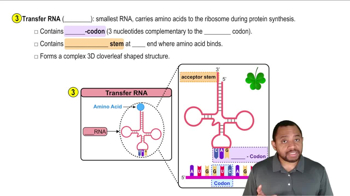
Understand the role of tRNA in protein synthesis: tRNA (transfer RNA) is responsible for bringing amino acids to the ribosome during translation. It contains anticodons, which are sequences of three nucleotides complementary to the codons on mRNA.
Review the structure of tRNA: tRNA molecules have a cloverleaf structure with an anticodon loop that pairs with the codon on mRNA. This ensures the correct amino acid is added to the growing polypeptide chain.
Compare tRNA with mRNA and rRNA: mRNA (messenger RNA) carries the genetic code from DNA to the ribosome, while rRNA (ribosomal RNA) is a structural and functional component of the ribosome. Neither mRNA nor rRNA contains anticodons.
Identify the key feature of tRNA: The presence of anticodons is unique to tRNA, as it directly interacts with mRNA codons during translation.
Conclude that the statement 'contains anticodons' matches tRNA, based on its function and structure in the process of translation.

Verified video answer for a similar problem:

This video solution was recommended by our tutors as helpful for the problem above.
Video duration:
1m
Was this helpful?

Key Concepts

Here are the essential concepts you must grasp in order to answer the question correctly.

mRNA (messenger RNA)

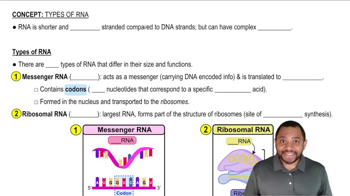
mRNA is a type of RNA that carries genetic information from DNA to the ribosome, where proteins are synthesized. It serves as a template for translation, dictating the sequence of amino acids in a protein. mRNA is synthesized during transcription and is crucial for conveying the instructions needed for protein production.
Recommended video:
Guided course
2:43
Types of RNA Concept 1

tRNA (transfer RNA)

tRNA is a type of RNA that plays a key role in translation by bringing amino acids to the ribosome. Each tRNA molecule has an anticodon that is complementary to a specific codon on the mRNA, ensuring that the correct amino acid is added to the growing polypeptide chain. This process is essential for accurate protein synthesis.
Recommended video:
Guided course
2:23
Types of RNA Concept 2

rRNA (ribosomal RNA)

rRNA is a structural and functional component of ribosomes, the cellular machinery responsible for protein synthesis. It helps to catalyze the formation of peptide bonds between amino acids and ensures the proper alignment of mRNA and tRNA during translation. rRNA is essential for the overall function of ribosomes in protein production.
Recommended video:
Guided course
2:43
Types of RNA Concept 1