Pearson+ LogoPearson+ Logo
Ch.4 Introduction to Organic Compounds
Frost - General, Organic and Biological Chemistry 4th Edition
Frost4th EditionGeneral, Organic and Biological ChemistryISBN: 9780134988696Not the one you use?Change textbook
Chapter 1, Problem 17c

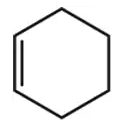
Identify the family of hydrocarbon present in the following:
(c)

Verified step by step guidance
1
Examine the structure of the hydrocarbon in the provided image. Look for key features such as the presence of single, double, or triple bonds, as well as any functional groups or ring structures.
Determine if the hydrocarbon contains only single bonds between carbon atoms. If so, it belongs to the alkane family, which are saturated hydrocarbons.
If the hydrocarbon contains at least one double bond between carbon atoms, it belongs to the alkene family, which are unsaturated hydrocarbons.
If the hydrocarbon contains at least one triple bond between carbon atoms, it belongs to the alkyne family, which are also unsaturated hydrocarbons.
If the hydrocarbon forms a ring structure, check if it is aromatic (contains a benzene ring or similar conjugated system) or cycloalkane (saturated ring structure). This will help identify if it belongs to the aromatic hydrocarbons or cycloalkanes.

Verified video answer for a similar problem:

This video solution was recommended by our tutors as helpful for the problem above.
Video duration:
1m
Was this helpful?

Key Concepts

Here are the essential concepts you must grasp in order to answer the question correctly.

Hydrocarbons

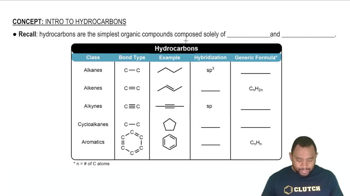
Hydrocarbons are organic compounds consisting entirely of hydrogen and carbon atoms. They are the fundamental building blocks of many organic molecules and can be classified into two main categories: aliphatic (which includes alkanes, alkenes, and alkynes) and aromatic hydrocarbons. Understanding the structure and properties of hydrocarbons is essential for identifying their family and behavior in chemical reactions.
Recommended video:
Guided course
4:29
Intro to Hydrocarbons Concept 1

Aliphatic vs. Aromatic Hydrocarbons

Aliphatic hydrocarbons are linear or branched chain compounds that can be saturated (alkanes) or unsaturated (alkenes and alkynes), while aromatic hydrocarbons contain one or more aromatic rings, characterized by delocalized pi electrons. The distinction between these two types is crucial for identifying the family of hydrocarbons present in a given structure, as they exhibit different chemical properties and reactivity.
Recommended video:
Guided course
4:29
Intro to Hydrocarbons Concept 1

Functional Groups

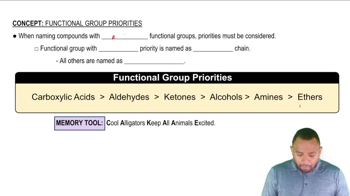
Functional groups are specific groups of atoms within molecules that are responsible for the characteristic chemical reactions of those molecules. In hydrocarbons, the presence of functional groups can indicate whether the compound is an alkane, alkene, alkyne, or aromatic compound. Identifying these groups is key to determining the family of hydrocarbons and predicting their behavior in chemical reactions.
Recommended video:
Guided course
1:11
Functional Group Priorities Concept 1