Pearson+ LogoPearson+ Logo
Ch.4 Introduction to Organic Compounds
Frost - General, Organic and Biological Chemistry 4th Edition
Frost4th EditionGeneral, Organic and Biological ChemistryISBN: 9780134988696Not the one you use?Change textbook
Chapter 1, Problem 17a

Identify the family of hydrocarbon present in the following:
(a) H3CC≡CH

Verified step by step guidance
1
Step 1: Recognize the molecular formula provided in the problem. The compound is H₃CC≡CH, which includes a triple bond between two carbon atoms.
Step 2: Recall the classification of hydrocarbons. Hydrocarbons are divided into four main families: alkanes (single bonds), alkenes (double bonds), alkynes (triple bonds), and aromatic hydrocarbons (ring structures with alternating double bonds).
Step 3: Identify the type of bond present in the compound. The presence of a triple bond (≡) between two carbon atoms indicates that this compound belongs to the alkyne family.
Step 4: Note the general formula for alkynes. Alkynes have the general formula CₙH₂ₙ₋₂, which matches the structure of H₃CC≡CH (C₃H₄).
Step 5: Conclude that the hydrocarbon family for H₃CC≡CH is 'alkyne' based on the presence of the triple bond and its adherence to the alkyne general formula.

Verified video answer for a similar problem:

This video solution was recommended by our tutors as helpful for the problem above.
Video duration:
2m
Was this helpful?

Key Concepts

Here are the essential concepts you must grasp in order to answer the question correctly.

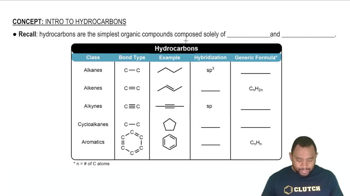
Hydrocarbons

Hydrocarbons are organic compounds consisting entirely of hydrogen and carbon atoms. They can be classified into different families based on their structure and bonding, including alkanes, alkenes, and alkynes. Understanding hydrocarbons is essential for identifying their properties and reactions in organic chemistry.
Recommended video:
Guided course
4:29
Intro to Hydrocarbons Concept 1

Alkynes

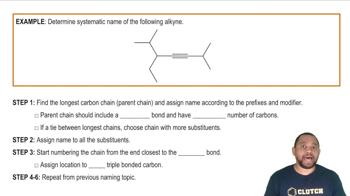
Alkynes are a family of hydrocarbons characterized by at least one carbon-carbon triple bond. The general formula for alkynes is CnH2n-2, where 'n' is the number of carbon atoms. The presence of a triple bond gives alkynes unique reactivity and properties compared to alkanes and alkenes.
Recommended video:
Guided course
4:11
Naming Alkynes Example 1

Nomenclature

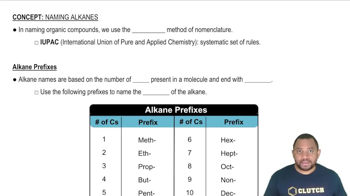
Nomenclature in organic chemistry refers to the systematic naming of chemical compounds based on their structure. For hydrocarbons, the IUPAC (International Union of Pure and Applied Chemistry) rules provide a standardized way to name compounds, which helps in identifying their family and structure. Proper nomenclature is crucial for clear communication in chemistry.
Recommended video:
Guided course
2:39
Rules for Naming Alkanes Concept 1