Pearson+ LogoPearson+ Logo
Ch.6 Carbohydrates Life's Sweet Molecules
Frost - General, Organic and Biological Chemistry 4th Edition
Frost4th EditionGeneral, Organic and Biological ChemistryISBN: 9780134988696Not the one you use?Change textbook
Chapter 3, Problem 38a

Lactulose is a disaccharide used in the treatment of chronic constipation. Its formal name is galactose β(1→4) fructose.
(a) Draw the structure of lactulose.

Verified step by step guidance
1
Understand the structure of lactulose: Lactulose is a disaccharide composed of galactose and fructose linked by a β(1→4) glycosidic bond. This means the bond connects the 1st carbon of galactose to the 4th carbon of fructose.
Draw the structure of galactose: Galactose is a hexose sugar with the molecular formula C₆H₁₂O₆. It has an aldehyde group (-CHO) at the first carbon and hydroxyl groups (-OH) attached to the other carbons in a specific orientation.
Draw the structure of fructose: Fructose is also a hexose sugar with the molecular formula C₆H₁₂O₆. It has a ketone group (C=O) at the second carbon and hydroxyl groups (-OH) attached to the other carbons in a specific orientation.
Link galactose and fructose: Use a β(1→4) glycosidic bond to connect the hydroxyl group on the 1st carbon of galactose to the hydroxyl group on the 4th carbon of fructose. Ensure the bond orientation matches the β configuration.
Finalize the structure: Verify that all atoms are correctly bonded, the glycosidic linkage is properly drawn, and the stereochemistry of galactose and fructose is accurate. Label the carbons and functional groups for clarity.

Verified video answer for a similar problem:

This video solution was recommended by our tutors as helpful for the problem above.
Video duration:
7m
Was this helpful?

Key Concepts

Here are the essential concepts you must grasp in order to answer the question correctly.

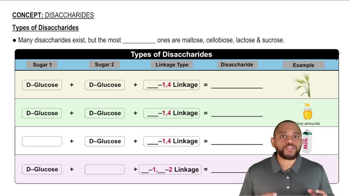
Disaccharides

Disaccharides are carbohydrates formed by the combination of two monosaccharides through a glycosidic bond. In the case of lactulose, it consists of galactose and fructose. Understanding disaccharides is essential for grasping how they function in the body, including their role in digestion and their effects on conditions like constipation.
Recommended video:
Guided course
3:39
Types of Disaccharides Concept 1

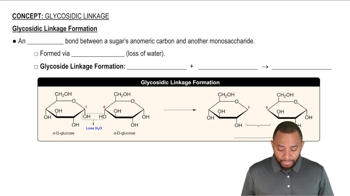
Glycosidic Bond

A glycosidic bond is a type of covalent bond that links a carbohydrate (sugar) molecule to another group, which can also be a carbohydrate. This bond is formed during a dehydration reaction, where a water molecule is released. Recognizing how glycosidic bonds form and their significance in carbohydrate structure is crucial for drawing and understanding the structure of lactulose.
Recommended video:
Guided course
1:44
Glycosidic Linkage Formation Concept 1

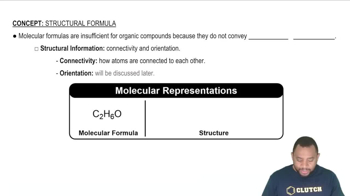
Chemical Structure Representation

Chemical structure representation involves illustrating the arrangement of atoms within a molecule, including bonds and functional groups. For lactulose, this means accurately depicting the two sugar units and their connections. Mastery of structural representation is vital for visualizing molecular interactions and predicting the behavior of compounds in biological systems.
Recommended video:
Guided course
2:08
Molecular Representations Concept 1