Pearson+ LogoPearson+ Logo
Ch.6 Carbohydrates Life's Sweet Molecules
Frost - General, Organic and Biological Chemistry 4th Edition
Frost4th EditionGeneral, Organic and Biological ChemistryISBN: 9780134988696Not the one you use?Change textbook
Chapter 3, Problem 32a

Identify the following reactions as condensation or hydrolysis:
(a) two monosaccharides reacting to form a disaccharide

Verified step by step guidance
1
Understand the definitions of condensation and hydrolysis reactions: Condensation reactions involve the combination of two molecules with the loss of a small molecule, often water. Hydrolysis reactions involve the breaking of a bond in a molecule using water.
Analyze the reaction described in part (a): Two monosaccharides are reacting to form a disaccharide. This suggests that two smaller molecules are combining to form a larger molecule.
Consider whether water is involved in the reaction: In the formation of a disaccharide from two monosaccharides, a molecule of water is typically lost during the process. This is a key characteristic of a condensation reaction.
Compare the reaction to the definition of condensation: Since two molecules are combining and water is lost, this aligns with the definition of a condensation reaction.
Conclude that the reaction described in part (a) is a condensation reaction based on the combination of two monosaccharides and the loss of water.

Verified video answer for a similar problem:

This video solution was recommended by our tutors as helpful for the problem above.
Video duration:
1m
Was this helpful?

Key Concepts

Here are the essential concepts you must grasp in order to answer the question correctly.

Condensation Reaction

A condensation reaction is a chemical process where two molecules combine to form a larger molecule, releasing a small molecule, often water, as a byproduct. In the context of carbohydrates, this reaction typically occurs when two monosaccharides join to form a disaccharide, resulting in the formation of a glycosidic bond.
Recommended video:
Guided course
1:53
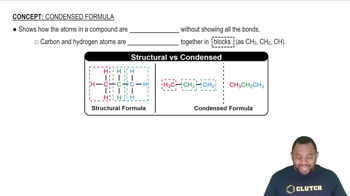
Condensed Formula Concept 1

Hydrolysis Reaction

Hydrolysis is a chemical reaction that involves the breaking down of a compound by the addition of water. In the case of carbohydrates, hydrolysis occurs when a disaccharide is split into two monosaccharides, breaking the glycosidic bond and utilizing water in the process. This reaction is essential for digestion and energy release.
Recommended video:
Guided course
3:09
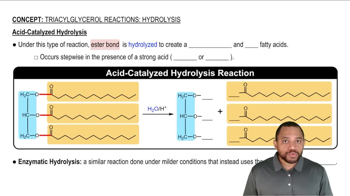
Triacylglycerol Reactions: Hydrolysis Concept 1

Glycosidic Bond

A glycosidic bond is a type of covalent bond that connects a carbohydrate (sugar) molecule to another group, which can be another carbohydrate or a different type of molecule. This bond is formed during condensation reactions and is crucial for the structure and function of polysaccharides and disaccharides in biological systems.
Recommended video:
Guided course
1:44
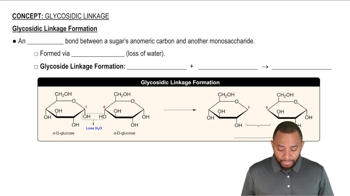
Glycosidic Linkage Formation Concept 1