Pearson+ LogoPearson+ Logo
Ch.6 Carbohydrates Life's Sweet Molecules
Frost - General, Organic and Biological Chemistry 4th Edition
Frost4th EditionGeneral, Organic and Biological ChemistryISBN: 9780134988696Not the one you use?Change textbook
Chapter 3, Problem 51

Write the molecular formula for a carbohydrate containing three carbons.

Verified step by step guidance
1
Understand that carbohydrates follow the general formula CnH2nOn, where 'n' represents the number of carbon atoms.
Identify that the problem specifies a carbohydrate containing three carbons, so n = 3.
Substitute n = 3 into the general formula to determine the molecular formula: C3H2(3)O3.
Simplify the formula by calculating the number of hydrogen atoms: H6 (since 2 × 3 = 6).
Combine the elements to write the molecular formula: C3H6O3, which represents a carbohydrate with three carbons.

Verified video answer for a similar problem:

This video solution was recommended by our tutors as helpful for the problem above.
Video duration:
4m
Was this helpful?

Key Concepts

Here are the essential concepts you must grasp in order to answer the question correctly.

Carbohydrates

Carbohydrates are organic compounds made up of carbon, hydrogen, and oxygen, typically in a ratio of 1:2:1. They serve as a primary energy source for living organisms and are classified into simple sugars (monosaccharides) and complex carbohydrates (polysaccharides). Understanding their structure is essential for determining their molecular formulas.
Recommended video:
Guided course
1:29
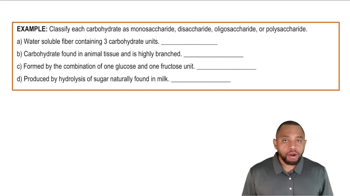
Classification of Carbohydrates Example 1

Molecular Formula

A molecular formula represents the number and types of atoms in a molecule, indicating the specific elements and their quantities. For carbohydrates, the formula is often expressed as Cn(H2O)n, where 'n' indicates the number of carbon atoms. This formula helps in identifying the composition of the carbohydrate.
Recommended video:
Guided course
02:08
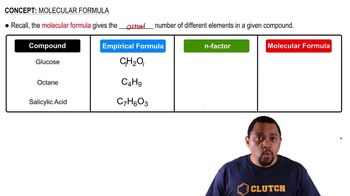
Molecular Formula

Triose

A triose is a type of monosaccharide that contains three carbon atoms. The two main forms of trioses are glyceraldehyde and dihydroxyacetone, which are important in metabolic pathways. Recognizing that a carbohydrate with three carbons is classified as a triose is crucial for accurately writing its molecular formula.
Recommended video:
Guided course
0:47
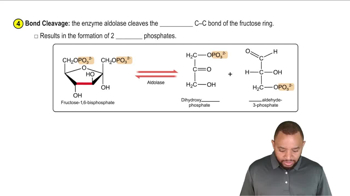
Glycolysis Concept 4