Pearson+ LogoPearson+ Logo
Ch.6 Chemical Reactions: Mole and Mass Relationships
McMurry - Fundamentals of GOB 8th Edition
McMurry8th EditionFundamentals of GOBISBN: 9780134015187Not the one you use?Change textbook
Chapter 6, Problem 18

Consider the balanced chemical equation: A2 + 2 B2 → 2 AB2. A reaction is performed with the initial amounts of A2 and B2 shown in part (a). The amount of product obtained is shown in part (b). Calculate the percent yield.
a. <IMAGE>
b. <IMAGE>

Verified step by step guidance
1
Step 1: Analyze the balanced chemical equation provided: A₂ + 2B₂ → 2AB₂. This equation indicates that one molecule of A₂ reacts with two molecules of B₂ to produce two molecules of AB₂.
Step 2: Count the initial number of molecules of A₂ and B₂ from the image labeled 'a'. There are 8 A₂ molecules and 16 B₂ molecules. These are the reactants available for the reaction.
Step 3: Determine the limiting reactant. Using the stoichiometric ratio from the balanced equation, 1 molecule of A₂ requires 2 molecules of B₂. Since there are 8 A₂ molecules, they would require 16 B₂ molecules to completely react. Both reactants are present in the exact stoichiometric ratio, so neither is in excess.
Step 4: Calculate the theoretical yield of AB₂. According to the balanced equation, 1 A₂ molecule produces 2 AB₂ molecules. Therefore, 8 A₂ molecules would theoretically produce 16 AB₂ molecules.
Step 5: Count the actual number of AB₂ molecules produced from the image labeled 'b'. There are 12 AB₂ molecules. Use the formula for percent yield: Percent Yield = (Actual Yield / Theoretical Yield) × 100. Substitute the values into the formula to calculate the percent yield.

Verified video answer for a similar problem:

This video solution was recommended by our tutors as helpful for the problem above.
Video duration:
4m
Was this helpful?

Key Concepts

Here are the essential concepts you must grasp in order to answer the question correctly.

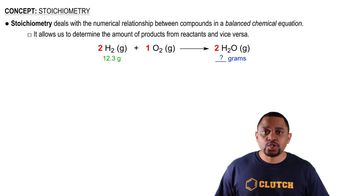
Stoichiometry

Stoichiometry is the branch of chemistry that deals with the quantitative relationships between the reactants and products in a chemical reaction. It allows chemists to predict the amounts of substances consumed and produced in a given reaction based on the balanced chemical equation. Understanding stoichiometry is essential for calculating theoretical yields and determining how much of each reactant is needed.
Recommended video:
Guided course
01:16
Stoichiometry

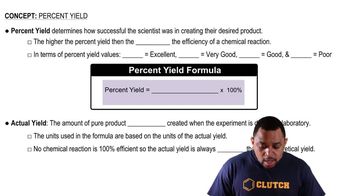
Percent Yield

Percent yield is a measure of the efficiency of a chemical reaction, calculated by comparing the actual yield of a product obtained from the reaction to the theoretical yield predicted by stoichiometry. It is expressed as a percentage and is calculated using the formula: (actual yield / theoretical yield) × 100%. A high percent yield indicates a successful reaction, while a low percent yield may suggest incomplete reactions or losses during the process.
Recommended video:
Guided course
03:09
Percent Yield

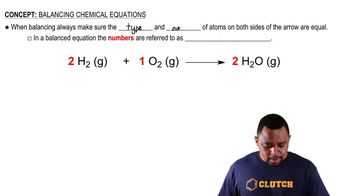
Balanced Chemical Equation

A balanced chemical equation represents a chemical reaction where the number of atoms for each element is the same on both sides of the equation. This balance ensures the law of conservation of mass is upheld, meaning matter is neither created nor destroyed in a chemical reaction. The coefficients in the equation indicate the ratios of reactants and products, which are crucial for stoichiometric calculations and determining yields.
Recommended video:
Guided course
01:32
Balancing Chemical Equations (Simplified) Concept 1