

Pearson+ LogoPearson+ Logo
Ch.9 Solutions
McMurry - Fundamentals of GOB 8th Edition
McMurry8th EditionFundamentals of GOBISBN: 9780134015187Not the one you use?Change textbook
Chapter 9, Problem 82

Which of the following solutions will give rise to a greater osmotic pressure at equilibrium: 5.00 g of NaCl in 350.0 mL water or 35.0 g of glucose in 400.0 mL water? For NaCl, MW = 58.5 amu; for glucose, MW = 180 amu.

Verified step by step guidance
1
Step 1: Recall the formula for osmotic pressure: Π = iMRT, where Π is the osmotic pressure, i is the van 't Hoff factor (number of particles the solute dissociates into), M is the molarity of the solution, R is the gas constant, and T is the temperature in Kelvin. Since R and T are constant for both solutions, compare the product of i and M for each solution to determine which has the greater osmotic pressure.
Step 2: Calculate the number of moles of NaCl. Use the formula: moles = mass / molar mass. For NaCl, the mass is 5.00 g and the molar mass is 58.5 g/mol. Substitute these values into the formula to find the moles of NaCl.
Step 3: Determine the molarity of the NaCl solution. Molarity (M) is calculated as moles of solute divided by the volume of solution in liters. Convert 350.0 mL to liters (350.0 mL = 0.350 L), then divide the moles of NaCl by 0.350 L to find the molarity. Remember that NaCl dissociates into two particles (Na⁺ and Cl⁻), so the van 't Hoff factor (i) for NaCl is 2.
Step 4: Calculate the number of moles of glucose. Use the formula: moles = mass / molar mass. For glucose, the mass is 35.0 g and the molar mass is 180 g/mol. Substitute these values into the formula to find the moles of glucose.
Step 5: Determine the molarity of the glucose solution. Convert 400.0 mL to liters (400.0 mL = 0.400 L), then divide the moles of glucose by 0.400 L to find the molarity. Since glucose does not dissociate in solution, its van 't Hoff factor (i) is 1. Compare the product of i and M for both solutions to determine which has the greater osmotic pressure.

Verified video answer for a similar problem:

This video solution was recommended by our tutors as helpful for the problem above.
Video duration:
14m
Was this helpful?

Key Concepts

Here are the essential concepts you must grasp in order to answer the question correctly.

Osmotic Pressure

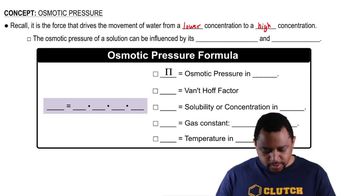
Osmotic pressure is the pressure required to prevent the flow of solvent into a solution through a semipermeable membrane. It is directly proportional to the concentration of solute particles in the solution. The formula for osmotic pressure (π) is π = iCRT, where 'i' is the van 't Hoff factor (number of particles the solute dissociates into), 'C' is the molarity of the solution, 'R' is the ideal gas constant, and 'T' is the temperature in Kelvin.
Recommended video:
Guided course
01:13
Osmotic Pressure Concept 1

Van 't Hoff Factor (i)

The van 't Hoff factor (i) indicates the number of particles a solute dissociates into in solution. For example, NaCl dissociates into two ions (Na+ and Cl-), giving it an i value of 2, while glucose does not dissociate and has an i value of 1. This factor is crucial for calculating osmotic pressure, as it affects the total concentration of solute particles in the solution.
Recommended video:
Guided course
01:56
Conversion Factors (Simplified) Concept 1

Molarity and Mass Calculations

Molarity (M) is a measure of concentration defined as the number of moles of solute per liter of solution. To compare osmotic pressures, one must first convert the mass of solute (in grams) to moles using the formula: moles = mass (g) / molar mass (g/mol). This allows for the calculation of molarity, which is essential for determining the osmotic pressure of each solution.
Recommended video:
Guided course
01:10
Calculating Molar Mass