The maximum amounts of lead and copper allowed in drinking water are 0.015 mg/kg for lead and 1.3 mg/kg for copper. Express these values in parts per million, and tell the maximum amount of each (in grams) allowed in 100 g of water.
Ch.9 Solutions
Chapter 9, Problem 19
The typical concentration of Mg2+ in blood is 3 mEq/L. How many milligrams of Mg2+ are in 250 mL of blood?
Verified step by step guidance1
Step 1: Understand the given information. The concentration of Mg²⁺ is provided as 3 mEq/L (milliequivalents per liter), and the volume of blood is 250 mL. The goal is to determine the mass of Mg²⁺ in milligrams.
Step 2: Convert the volume of blood from milliliters to liters, since the concentration is given in mEq/L. Use the conversion factor: 1 L = 1000 mL. The formula is: \( \text{Volume in liters} = \frac{\text{Volume in mL}}{1000} \).
Step 3: Calculate the total milliequivalents of Mg²⁺ in the given volume of blood. Use the formula: \( \text{Total mEq} = \text{Concentration (mEq/L)} \times \text{Volume (L)} \).
Step 4: Convert milliequivalents (mEq) to millimoles (mmol). For Mg²⁺, 1 mEq corresponds to 0.5 mmol because the charge of Mg²⁺ is +2. Use the formula: \( \text{mmol} = \text{mEq} \times 0.5 \).
Step 5: Convert millimoles to milligrams. The molar mass of Mg²⁺ is approximately 24.31 g/mol. Use the formula: \( \text{Mass in mg} = \text{mmol} \times \text{Molar mass (mg/mmol)} \), where \( \text{Molar mass (mg/mmol)} = 24.31 \).

Verified video answer for a similar problem:
This video solution was recommended by our tutors as helpful for the problem above.
Video duration:
3mWas this helpful?
Key Concepts
Here are the essential concepts you must grasp in order to answer the question correctly.
Milliequivalents (mEq)
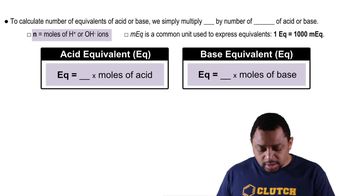
Milliequivalents (mEq) is a unit of measurement used to express the concentration of ions in a solution. It accounts for the charge of the ion, allowing for a standardized way to compare different ions. For magnesium (Mg²⁺), 1 mEq corresponds to 1 millimole of the ion, considering its valence of +2. Understanding mEq is crucial for converting between different units of concentration.
Recommended video:
Guided course
Acid-Base Equivalents Concept 2
Concentration Calculation
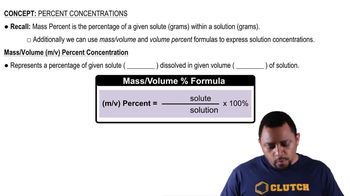
Concentration calculation involves determining the amount of a substance in a given volume of solution. In this case, the concentration of Mg²⁺ is given as 3 mEq/L, which means there are 3 milliequivalents of magnesium in one liter of blood. To find the total amount in 250 mL, one must convert the volume from liters to milliliters and apply the concentration to find the total mEq present.
Recommended video:
Guided course
Percent Concentrations Concept 1
Conversion from mEq to mg
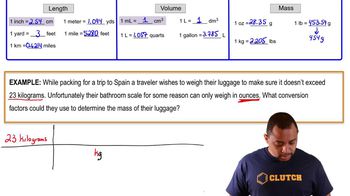
To convert milliequivalents (mEq) of an ion to milligrams (mg), one must use the molecular weight of the ion. For magnesium, the atomic weight is approximately 24.3 g/mol. The conversion formula is: mg = mEq × (molecular weight / valence). This step is essential for translating the concentration of Mg²⁺ in mEq to its mass in mg, which is necessary for the final answer.
Recommended video:
Guided course
Conversion Factors (Simplified) Example 2
Related Practice
Textbook Question
2104
views
Textbook Question
The concentration of cholesterol (C27H46O) in blood is approximately 5.0 mM. How many grams of cholesterol are in 250 mL of blood?
2081
views
Textbook Question
The Environmental Protection Agency has set the limit for arsenic in drinking water at 0.010 ppm. To what volume would you need to dilute 1.5 L of water containing 5.0 ppm arsenic to reach the acceptable limit?
1776
views
Textbook Question
When 1.0 mol of HF is dissolved in 1.0 kg of water, the boiling point of the resulting solution is 100.5 °C. Is HF a strong or weak electrolyte? Explain.
2265
views
Textbook Question
The diagram to the right shows plots of vapor pressure versus temperature for a solvent and a solution.
b. What is the approximate boiling-point elevation for the solution?
<IMAGE>
2084
views
Textbook Question
The diagram to the right shows plots of vapor pressure versus temperature for a solvent and a solution.
c. What is the approximate concentration of the solution in mol/kg, if 1 mol of solute particles raises the boiling point of 1 kg of solvent by 3.63 °C?
<IMAGE>
2179
views