Pearson+ LogoPearson+ Logo
Ch.12 Introduction to Organic Chemistry: Alkanes
McMurry - Fundamentals of GOB 8th Edition
McMurry8th EditionFundamentals of GOBISBN: 9780134015187Not the one you use?Change textbook
Chapter 12, Problem 14a

Draw and name alkanes that meet the following descriptions:
a. A 5-carbon alkane with a tertiary carbon atom

Verified step by step guidance
1
Step 1: Understand the problem. You are tasked with drawing and naming a 5-carbon alkane that contains a tertiary carbon atom. A tertiary carbon atom is a carbon atom bonded to three other carbon atoms.
Step 2: Start by constructing the main chain of the alkane. Since the molecule has 5 carbons, the parent chain will be pentane (C₅H₁₂).
Step 3: To include a tertiary carbon atom, one of the carbons in the chain must be bonded to three other carbons. This requires branching. Choose one of the middle carbons in the chain (e.g., carbon 2 or carbon 3) to serve as the tertiary carbon.
Step 4: Add a methyl group (-CH₃) as a branch to the chosen middle carbon. This creates a structure where the middle carbon is bonded to three other carbons (two from the main chain and one from the branch).
Step 5: Name the compound according to IUPAC nomenclature. Identify the longest continuous chain of carbons (still 5 carbons, so the parent name is pentane), number the chain to give the branch the lowest possible number, and name the branch as a substituent (e.g., 2-methylpentane or 3-methylpentane, depending on the position of the branch).

Verified video answer for a similar problem:

This video solution was recommended by our tutors as helpful for the problem above.
Was this helpful?

Key Concepts

Here are the essential concepts you must grasp in order to answer the question correctly.

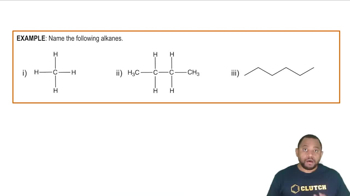
Alkanes

Alkanes are saturated hydrocarbons consisting only of carbon (C) and hydrogen (H) atoms, connected by single bonds. They follow the general formula CnH2n+2, where 'n' is the number of carbon atoms. Alkanes are characterized by their relatively low reactivity and are commonly found in natural gas and petroleum.
Recommended video:
Guided course
1:20
Naming Alkanes Example 1

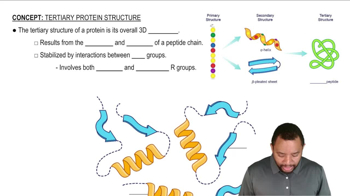
Tertiary Carbon

A tertiary carbon atom is a carbon atom that is bonded to three other carbon atoms. This structure is significant in organic chemistry as it influences the stability and reactivity of the molecule. In alkanes, the presence of a tertiary carbon can affect the compound's physical properties and its behavior in chemical reactions.
Recommended video:
Guided course
2:07
Tertiary Protein Structure Concept 1

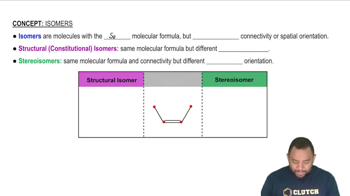
Structural Isomers

Structural isomers are compounds that have the same molecular formula but differ in the arrangement of atoms. In the case of alkanes, different structural isomers can arise from variations in the branching of the carbon chain. Understanding structural isomers is crucial for identifying and naming alkanes, especially when specific structural features, like tertiary carbons, are required.
Recommended video:
Guided course
2:16
Isomers Concept 1