Pearson+ LogoPearson+ Logo
Ch.12 Introduction to Organic Chemistry: Alkanes
McMurry - Fundamentals of GOB 8th Edition
McMurry8th EditionFundamentals of GOBISBN: 9780134015187Not the one you use?Change textbook
Chapter 12, Problem 13c

Draw both condensed and line structures corresponding to the following IUPAC names and label each carbon as primary, secondary, tertiary, or quaternary.
c. 2,2,4-Trimethylpentane

Verified step by step guidance
1
Step 1: Start by analyzing the IUPAC name '2,2,4-Trimethylpentane'. The parent chain is 'pentane', which means the main chain contains 5 carbon atoms connected in a straight chain. The prefixes '2,2,4-Trimethyl' indicate that there are three methyl (-CH₃) groups attached to the main chain: two on carbon 2 and one on carbon 4.
Step 2: Draw the condensed structure. Begin with the main chain of 5 carbons (pentane). Add the methyl groups to the appropriate carbons: two methyl groups on carbon 2 and one methyl group on carbon 4. The condensed structure will look like this: CH₃C(CH₃)₂CH₂CH(CH₃)CH₃.
Step 3: Draw the line structure. Represent the main chain as a zigzag line with 5 vertices (each vertex represents a carbon atom). Add branches for the methyl groups: two branches on the second vertex (carbon 2) and one branch on the fourth vertex (carbon 4). Ensure the structure reflects the correct connectivity.
Step 4: Label each carbon atom as primary, secondary, tertiary, or quaternary. A primary carbon is bonded to one other carbon, a secondary carbon is bonded to two other carbons, a tertiary carbon is bonded to three other carbons, and a quaternary carbon is bonded to four other carbons. For example, the central carbon at position 2 is quaternary because it is bonded to four carbons (two methyl groups and two carbons from the main chain).
Step 5: Verify the structure and labels. Double-check that the condensed and line structures match the IUPAC name and that each carbon is correctly labeled. This ensures the structure is accurate and consistent with the given name.

Verified video answer for a similar problem:

This video solution was recommended by our tutors as helpful for the problem above.
Was this helpful?

Key Concepts

Here are the essential concepts you must grasp in order to answer the question correctly.

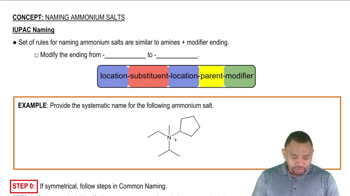
IUPAC Nomenclature

IUPAC nomenclature is a systematic method for naming organic chemical compounds. It provides a set of rules to derive the names based on the structure of the molecule, including the longest carbon chain and the position of substituents. Understanding these rules is essential for accurately interpreting and drawing the structures of compounds like 2,2,4-trimethylpentane.
Recommended video:
Guided course
3:18
IUPAC Naming Concept 3

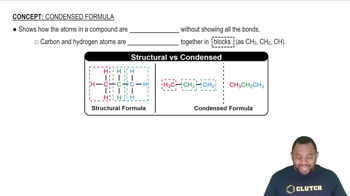
Condensed and Line Structures

Condensed and line structures are two ways to represent chemical compounds visually. A condensed structure shows the arrangement of atoms in a more compact form, while a line structure uses lines to represent bonds between atoms, emphasizing the connectivity and geometry of the molecule. Both representations are crucial for understanding the molecular structure and for identifying functional groups and substituents.
Recommended video:
Guided course
1:53
Condensed Formula Concept 1

Carbon Classification

Carbon classification refers to categorizing carbon atoms based on their bonding environment. Carbons can be classified as primary (attached to one other carbon), secondary (attached to two), tertiary (attached to three), or quaternary (attached to four). This classification is important for understanding the reactivity and stability of the molecule, as well as for labeling the carbons in the given compound.
Recommended video:
Guided course
04:19
Classification of Matter