Pearson+ LogoPearson+ Logo
Ch.12 Introduction to Organic Chemistry: Alkanes
McMurry - Fundamentals of GOB 8th Edition
McMurry8th EditionFundamentals of GOBISBN: 9780134015187Not the one you use?Change textbook
Chapter 12, Problem 31a

For each of the following, give an example of a member compound containing 5 carbons total:
(a) Alcohol

Verified step by step guidance
1
Step 1: Recall the general structure of an alcohol. Alcohols are organic compounds that contain a hydroxyl group (-OH) attached to a carbon atom.
Step 2: Understand that the compound must have a total of 5 carbon atoms. This means the carbon chain (or backbone) should sum up to 5 carbons, which can be arranged in a straight chain or branched structure.
Step 3: Choose a specific arrangement of the 5 carbons. For example, you can use a straight-chain structure (pentane) or a branched structure (e.g., isopentane).
Step 4: Replace one hydrogen atom in the chosen carbon chain with a hydroxyl group (-OH) to form the alcohol. For instance, if you start with pentane (C5H12), replacing one hydrogen atom with -OH gives you pentanol (C5H11OH).
Step 5: Verify that the resulting compound is an alcohol and contains exactly 5 carbons. Ensure the hydroxyl group is correctly attached to one of the carbon atoms, and the total number of carbons in the structure is 5.

Verified video answer for a similar problem:

This video solution was recommended by our tutors as helpful for the problem above.
Was this helpful?

Key Concepts

Here are the essential concepts you must grasp in order to answer the question correctly.

Alcohols

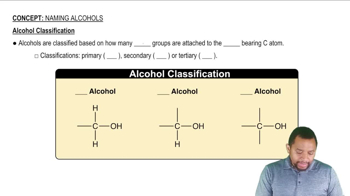
Alcohols are organic compounds characterized by the presence of one or more hydroxyl (-OH) groups attached to a carbon atom. They can be classified based on the number of carbon atoms and the structure of the carbon chain. For example, pentanol is a five-carbon alcohol with the formula C5H12O, which can exist in several structural isomers.
Recommended video:
Guided course
1:10
Alcohol Classification Concept 2

Isomerism

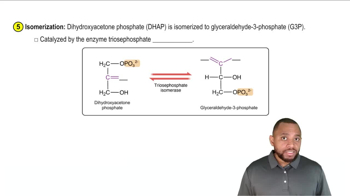
Isomerism refers to the phenomenon where compounds with the same molecular formula can have different structural arrangements or spatial orientations. In the case of five-carbon alcohols, there are several isomers, such as 1-pentanol, 2-pentanol, and 3-pentanol, each differing in the position of the hydroxyl group on the carbon chain.
Recommended video:
Guided course
1:26
Glycolysis Concept 5

Functional Groups

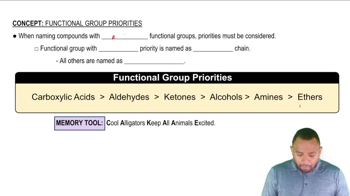
Functional groups are specific groups of atoms within molecules that are responsible for the characteristic chemical reactions of those molecules. In alcohols, the hydroxyl group (-OH) is the functional group that defines their properties and reactivity, distinguishing them from other organic compounds like aldehydes or ketones.
Recommended video:
Guided course
1:11
Functional Group Priorities Concept 1