Pearson+ LogoPearson+ Logo
Ch.12 Introduction to Organic Chemistry: Alkanes
McMurry - Fundamentals of GOB 8th Edition
McMurry8th EditionFundamentals of GOBISBN: 9780134015187Not the one you use?Change textbook
Chapter 12, Problem 29

Why are most organic compounds nonconducting and insoluble in water?

Verified step by step guidance
1
Organic compounds are primarily composed of carbon and hydrogen atoms, which form covalent bonds. Covalent bonds involve the sharing of electrons between atoms, resulting in molecules that do not have free-moving charged particles necessary for electrical conductivity.
Most organic compounds are nonpolar or have low polarity. Water is a polar solvent, and according to the principle 'like dissolves like,' nonpolar substances do not dissolve well in polar solvents like water.
The lack of charged particles in organic compounds means they do not dissociate into ions in solution, which is a requirement for conductivity in aqueous solutions.
Many organic compounds have large, complex structures with significant hydrophobic (water-repelling) regions, which further reduces their solubility in water.
Some organic compounds can dissolve in water if they contain functional groups that can form hydrogen bonds with water molecules, but these are exceptions rather than the rule.

Verified video answer for a similar problem:

This video solution was recommended by our tutors as helpful for the problem above.
Was this helpful?

Key Concepts

Here are the essential concepts you must grasp in order to answer the question correctly.

Polarity of Molecules

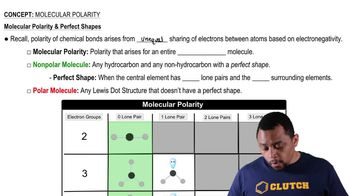
Polarity refers to the distribution of electrical charge over the atoms in a molecule. Organic compounds, which often consist of carbon and hydrogen, tend to be nonpolar due to their symmetrical structure and lack of significant electronegative atoms. This nonpolarity results in poor solubility in polar solvents like water, which is highly polar.
Recommended video:
Guided course
01:34
Molecular Polarity (Simplified) Concept 1

Ionic vs. Covalent Bonds

Organic compounds primarily consist of covalent bonds, where electrons are shared between atoms. In contrast, ionic compounds, which dissolve in water and conduct electricity, consist of charged ions. The covalent nature of organic compounds means they do not dissociate into ions in solution, leading to their nonconducting properties.
Recommended video:
Guided course
01:13
Covalent Bonds Example 2

Hydrophobic Effect

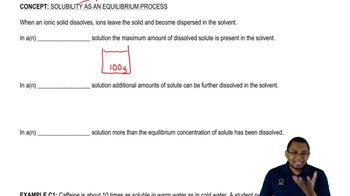
The hydrophobic effect describes how nonpolar substances tend to aggregate in aqueous solutions to minimize their exposure to water. Most organic compounds are hydrophobic, meaning they do not interact favorably with water molecules. This characteristic contributes to their insolubility in water and reinforces their nonconducting nature, as they do not facilitate the movement of charged particles.
Recommended video:
Guided course
04:38
Solubility: Temperature Effect Concept 1