Pearson+ LogoPearson+ Logo
Ch.13 Alkenes, Alkynes, and Aromatic Compounds
McMurry - Fundamentals of GOB 8th Edition
McMurry8th EditionFundamentals of GOBISBN: 9780134015187Not the one you use?Change textbook
Chapter 13, Problem 52

What is the difference between a substitution reaction and an addition reaction?

Verified step by step guidance
1
Identify the type of reactants involved: In a substitution reaction, a functional group in a molecule is replaced by another group. In an addition reaction, multiple reactants combine to form a single product without any atoms being left out.
Examine the reaction mechanism: Substitution reactions typically involve the replacement of an atom or group (e.g., halogen in alkyl halides) by another atom or group (e.g., OH- in hydrolysis reactions). Addition reactions involve the breaking of double or triple bonds in molecules like alkenes or alkynes to add atoms or groups across the bond.
Consider the products formed: In substitution reactions, the main product is a molecule with a new group or atom in place of the original one, and a by-product is often formed (e.g., displaced halide ion). In addition reactions, the product is a more complex molecule with no small by-products.
Analyze the reaction conditions: Substitution reactions often require a good leaving group and a nucleophile, and can be facilitated by solvents that stabilize ions. Addition reactions typically need unsaturated compounds and can be catalyzed by acids or bases.
Understand the application and occurrence: Substitution reactions are common in organic synthesis and biological processes, such as DNA replication. Addition reactions are crucial in forming polymers and are widely used in industrial chemical processes.

Key Concepts

Here are the essential concepts you must grasp in order to answer the question correctly.

Substitution Reaction

A substitution reaction is a type of chemical reaction where one functional group in a chemical compound is replaced by another. This process typically involves the breaking of a bond and the formation of a new bond, resulting in a product that retains the original compound's structure but with a different substituent. Common examples include the halogenation of alkanes, where a hydrogen atom is replaced by a halogen.
Recommended video:
Guided course
5:07
Naming Alkanes with Substituents Example 1

Addition Reaction

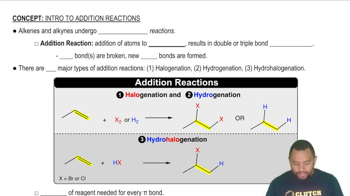
An addition reaction occurs when two or more reactants combine to form a single product, often involving the addition of atoms or groups to a double or triple bond in an unsaturated compound. This reaction typically results in an increase in the number of bonds and can lead to the formation of larger, more complex molecules. A common example is the hydrogenation of alkenes, where hydrogen is added across a double bond.
Recommended video:
Guided course
2:55
Addition Reactions Concept 1

Functional Groups

Functional groups are specific groups of atoms within molecules that are responsible for the characteristic chemical reactions of those molecules. They determine the properties and reactivity of organic compounds, influencing whether a reaction will be a substitution or addition. Understanding functional groups is essential for predicting the behavior of organic reactions and the types of products formed.
Recommended video:
Guided course
1:11
Functional Group Priorities Concept 1