Pearson+ LogoPearson+ Logo
Ch.16 Amines
McMurry - Fundamentals of GOB 8th Edition
McMurry8th EditionFundamentals of GOBISBN: 9780134015187Not the one you use?Change textbook
Chapter 16, Problem 6

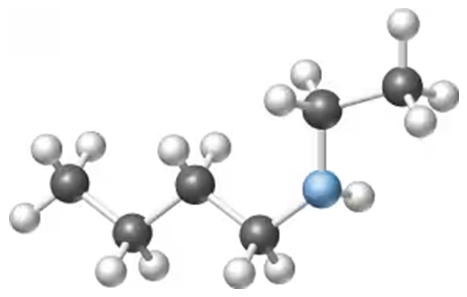
Draw the condensed and line formula of the molecule in the margin. Is it a primary, secondary, or tertiary amine? Why?

Verified step by step guidance
1
Examine the structure of the molecule provided in the image. Identify the nitrogen atom (N) and its bonding pattern to determine if it is part of an amine group.
To draw the condensed formula, write the molecule in a linear format, showing all atoms explicitly but grouping hydrogen atoms with their attached carbon or nitrogen atoms. For example, CH3-NH2 for a simple amine.
To draw the line formula, represent the molecule using lines for bonds between carbon atoms, omitting hydrogen atoms bonded to carbons, and explicitly showing the nitrogen atom and its bonds.
Determine if the amine is primary, secondary, or tertiary by counting the number of carbon-containing groups (alkyl or aryl groups) directly attached to the nitrogen atom. A primary amine has one carbon group, a secondary amine has two, and a tertiary amine has three.
Explain your reasoning: Based on the bonding pattern of the nitrogen atom, classify the amine as primary, secondary, or tertiary. Justify your answer by referencing the number of carbon groups attached to the nitrogen.

Verified video answer for a similar problem:

This video solution was recommended by our tutors as helpful for the problem above.
Was this helpful?

Key Concepts

Here are the essential concepts you must grasp in order to answer the question correctly.

Condensed and Line Formula

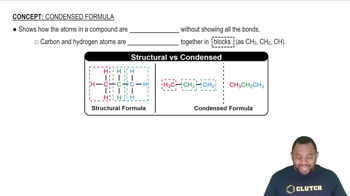
The condensed formula of a molecule provides a shorthand representation of its structure, showing the types and numbers of atoms without depicting all bonds explicitly. The line formula, on the other hand, uses lines to represent bonds between atoms, simplifying the visualization of complex structures. Understanding these formulas is essential for identifying functional groups and the overall structure of organic compounds.
Recommended video:
Guided course
1:53
Condensed Formula Concept 1

Amines Classification

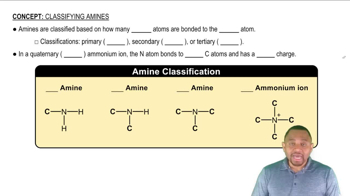
Amines are classified based on the number of carbon groups attached to the nitrogen atom. A primary amine has one carbon group, a secondary amine has two, and a tertiary amine has three. This classification is crucial for understanding the reactivity and properties of amines, as each type exhibits different chemical behaviors and interactions.
Recommended video:
Guided course
1:26
Amine Classification Concept 1

Functional Groups

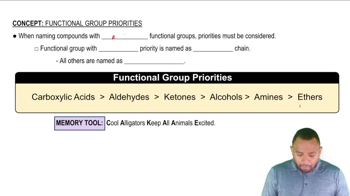
Functional groups are specific groups of atoms within molecules that are responsible for the characteristic chemical reactions of those molecules. In the case of amines, the presence of the -NH2, -NHR, or -NR2 groups defines their behavior and reactivity. Recognizing functional groups is vital for predicting how a molecule will interact in chemical reactions and for classifying organic compounds.
Recommended video:
Guided course
1:11
Functional Group Priorities Concept 1