
Pearson+ LogoPearson+ Logo
Ch.17 Carboxylic Acids and Their Derivatives
McMurry - Fundamentals of GOB 8th Edition
McMurry8th EditionFundamentals of GOBISBN: 9780134015187Not the one you use?Change textbook
Chapter 17, Problem 23a

Draw the products you would obtain from acid-catalyzed hydrolysis of the following esters.
a. Isopropyl benzoate

Verified step by step guidance
1
Identify the functional group in the compound. Isopropyl benzoate is an ester, which has the general structure RCOOR'. In this case, the R group is a benzene ring (benzoate), and the R' group is an isopropyl group.
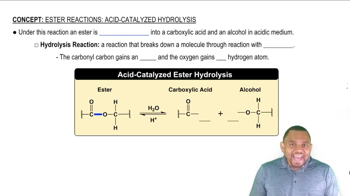
Understand the reaction type. Acid-catalyzed hydrolysis of an ester involves breaking the ester bond in the presence of water and an acid catalyst, such as HCl or H2SO4. This reaction produces a carboxylic acid and an alcohol.
Write the general reaction for ester hydrolysis: RCOOR' + H2ORCOOH + R'OH. Here, the ester breaks into a carboxylic acid (RCOOH) and an alcohol (R'OH).
Apply the reaction to isopropyl benzoate. The ester bond between the benzene ring (R group) and the isopropyl group (R' group) will break. The benzene ring will form benzoic acid (CH6HCOOH), and the isopropyl group will form isopropanol (CH3CHOH).
Draw the products. The products of the reaction are benzoic acid and isopropanol. Represent benzoic acid with a benzene ring attached to a carboxylic acid group (-COOH) and isopropanol as a three-carbon chain with a hydroxyl group (-OH) on the middle carbon.

Verified video answer for a similar problem:

This video solution was recommended by our tutors as helpful for the problem above.
Was this helpful?

Key Concepts

Here are the essential concepts you must grasp in order to answer the question correctly.

Acid-Catalyzed Hydrolysis

Acid-catalyzed hydrolysis is a chemical reaction where an ester reacts with water in the presence of an acid catalyst, typically a strong acid like sulfuric acid. This process breaks the ester bond, resulting in the formation of an alcohol and a carboxylic acid. The acid catalyst increases the reaction rate by protonating the carbonyl oxygen, making the carbon more electrophilic and susceptible to nucleophilic attack by water.
Recommended video:
Guided course
1:14
Acid-Catalyzed Ester Hydrolysis Concept 1

Esters

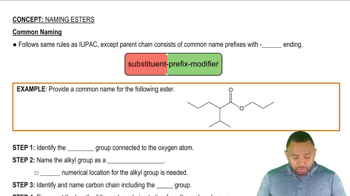
Esters are organic compounds formed from the reaction of an alcohol and a carboxylic acid, characterized by the functional group -COO-. They often have distinctive fruity odors and are commonly found in natural and synthetic substances. In the context of hydrolysis, esters can be converted back into their parent alcohol and carboxylic acid through the addition of water, facilitated by an acid catalyst.
Recommended video:
Guided course
3:30
Common Naming: Esters Concept 2

Products of Hydrolysis

The products of acid-catalyzed hydrolysis of an ester include an alcohol and a carboxylic acid. For isopropyl benzoate, the hydrolysis would yield isopropanol (the alcohol) and benzoic acid (the carboxylic acid). Understanding the structure of the starting ester is crucial for predicting the specific products formed during the hydrolysis reaction.
Recommended video:
Guided course
0:52
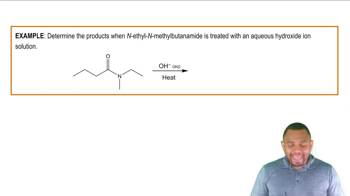
Basic Hydrolysis Example 2