Pearson+ LogoPearson+ Logo
Ch.17 Carboxylic Acids and Their Derivatives
McMurry - Fundamentals of GOB 8th Edition
McMurry8th EditionFundamentals of GOBISBN: 9780134015187Not the one you use?Change textbook
Chapter 17, Problem 50

What is the formula for the diammonium salt of fumaric acid?

Verified step by step guidance
1
Understand the components of the compound: Fumaric acid is a dicarboxylic acid with the formula \( \text{C}_4\text{H}_4\text{O}_4 \), and diammonium indicates that two ammonium ions (\( \text{NH}_4^+ \)) are involved.
Recognize that fumaric acid has two carboxylic acid groups (\( \text{-COOH} \)) that can each lose a proton (\( \text{H}^+ \)) to form carboxylate ions (\( \text{-COO}^- \)).
When both carboxylic acid groups lose their protons, the resulting anion is the fumarate ion, \( \text{C}_4\text{H}_2\text{O}_4^{2-} \).
Combine the fumarate ion (\( \text{C}_4\text{H}_2\text{O}_4^{2-} \)) with two ammonium ions (\( \text{NH}_4^+ \)) to form the diammonium salt. The formula of the diammonium salt is \( (\text{NH}_4)_2\text{C}_4\text{H}_2\text{O}_4 \).
Verify the charge balance: The two \( \text{NH}_4^+ \) ions (total charge \( +2 \)) balance the \( \text{C}_4\text{H}_2\text{O}_4^{2-} \) ion (charge \( -2 \)), ensuring the compound is neutral.

Verified video answer for a similar problem:

This video solution was recommended by our tutors as helpful for the problem above.
Was this helpful?

Key Concepts

Here are the essential concepts you must grasp in order to answer the question correctly.

Fumaric Acid

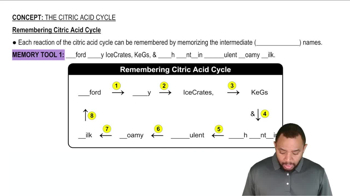
Fumaric acid is a dicarboxylic acid with the chemical formula C4H4O4. It is an unsaturated compound that plays a significant role in various biochemical processes, including the citric acid cycle. Understanding its structure and properties is essential for deriving its salts, such as diammonium fumarate.
Recommended video:
Guided course
2:12
Remembering Citric Acid Cycle Concept 15

Diammonium Salt

A diammonium salt is formed when two ammonium ions (NH4+) replace the hydrogen ions in an acid. In the case of fumaric acid, the formation of diammonium fumarate involves the reaction of fumaric acid with ammonia, resulting in a salt that can be used in various applications, including fertilizers and pharmaceuticals.
Recommended video:

Chemical Formula Derivation

Deriving the chemical formula for a compound involves understanding the stoichiometry of the reactants and products. For diammonium fumarate, one must consider the original fumaric acid formula and the addition of two ammonium ions, leading to the final formula of (NH4)2C4H4O4. This process is crucial for accurately representing the compound's composition.
Recommended video:
Guided course
00:47
The Ideal Gas Law Derivations