
Pearson+ LogoPearson+ Logo
Ch.22 Carbohydrate Metabolism
McMurry - Fundamentals of GOB 8th Edition
McMurry8th EditionFundamentals of GOBISBN: 9780134015187Not the one you use?Change textbook
Chapter 22, Problem 12

Glycolysis of one molecule of glucose produces 8 ATP molecules. How many ATP molecules are produced from glycolysis of 10 glucose molecules?

Verified step by step guidance
1
Step 1: Understand the problem. Glycolysis is a metabolic pathway that breaks down one molecule of glucose to produce 8 ATP molecules. The question asks how many ATP molecules are produced when 10 glucose molecules undergo glycolysis.
Step 2: Identify the relationship between glucose molecules and ATP production. From the problem, we know that 1 glucose molecule produces 8 ATP molecules. This can be expressed as a proportional relationship: \( \text{ATP produced} = 8 \times \text{number of glucose molecules} \).
Step 3: Substitute the given number of glucose molecules into the equation. In this case, the number of glucose molecules is 10. The equation becomes: \( \text{ATP produced} = 8 \times 10 \).
Step 4: Perform the multiplication to determine the total ATP molecules produced. Multiply 8 by 10 to find the result.
Step 5: Conclude that the total number of ATP molecules produced from glycolysis of 10 glucose molecules is the result of the multiplication in Step 4.

Verified video answer for a similar problem:

This video solution was recommended by our tutors as helpful for the problem above.
Video duration:
2m
Was this helpful?

Key Concepts

Here are the essential concepts you must grasp in order to answer the question correctly.

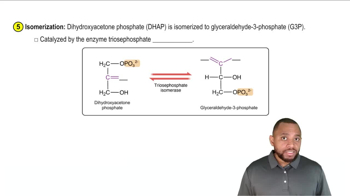
Glycolysis

Glycolysis is a metabolic pathway that converts glucose into pyruvate, producing energy in the form of ATP. This process occurs in the cytoplasm of cells and is anaerobic, meaning it does not require oxygen. For each molecule of glucose, glycolysis yields a net gain of 2 ATP molecules, although the total production can be higher when considering the energy carriers generated.
Recommended video:
Guided course
1:26
Glycolysis Concept 5

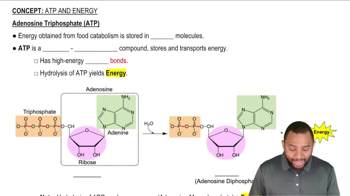
ATP Production

Adenosine triphosphate (ATP) is the primary energy currency of the cell, used to power various biological processes. In glycolysis, the breakdown of one glucose molecule typically results in the production of 2 ATP molecules directly, along with additional energy carriers. Understanding the ATP yield from glycolysis is crucial for calculating energy production from multiple glucose molecules.
Recommended video:
Guided course
2:20
Adenosine Triphosphate (ATP) Concept 2

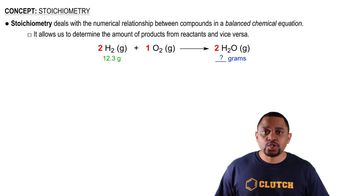
Stoichiometry in Biochemical Reactions

Stoichiometry refers to the quantitative relationship between reactants and products in a chemical reaction. In the context of glycolysis, it allows us to determine how many ATP molecules are produced from a given number of glucose molecules. By applying stoichiometric principles, we can scale the ATP yield from one glucose molecule to multiple molecules, facilitating accurate calculations in metabolic pathways.
Recommended video:
Guided course
01:16
Stoichiometry