Pearson+ LogoPearson+ Logo
Ch.22 Carbohydrate Metabolism
McMurry - Fundamentals of GOB 8th Edition
McMurry8th EditionFundamentals of GOBISBN: 9780134015187Not the one you use?Change textbook
Chapter 22, Problem 47b

How many moles of ATP are produced by phosphorylation in the following?
b. Aerobic conversion of 1 mol of pyruvate to 1 mol of acetyl-CoA

Verified step by step guidance
1
Understand the context: The aerobic conversion of pyruvate to acetyl-CoA occurs in the mitochondria and is catalyzed by the pyruvate dehydrogenase complex. This process is part of cellular respiration and involves the production of NADH, which can later contribute to ATP production through oxidative phosphorylation.
Identify the key reaction: The conversion of 1 mol of pyruvate to 1 mol of acetyl-CoA produces 1 mol of NADH as a byproduct. This is a critical step because NADH is an electron carrier that will be used in the electron transport chain to generate ATP.
Determine the ATP yield from NADH: In the electron transport chain, each NADH molecule contributes to the production of approximately 2.5 moles of ATP through oxidative phosphorylation. This is a standard value used in biochemistry.
Relate the NADH produced to ATP: Since 1 mol of pyruvate produces 1 mol of NADH during its conversion to acetyl-CoA, the ATP yield from this process can be calculated by multiplying the number of NADH molecules (1 mol) by the ATP yield per NADH (2.5 mol ATP per mol NADH).
Summarize the result: The total number of moles of ATP produced by phosphorylation during the aerobic conversion of 1 mol of pyruvate to 1 mol of acetyl-CoA is determined by the calculation in the previous step. This value represents the ATP contribution from this specific biochemical reaction.

Verified video answer for a similar problem:

This video solution was recommended by our tutors as helpful for the problem above.
Video duration:
3m
Was this helpful?

Key Concepts

Here are the essential concepts you must grasp in order to answer the question correctly.

ATP Production

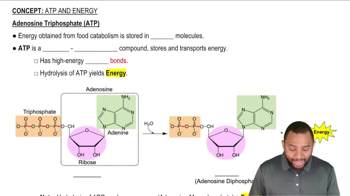
Adenosine triphosphate (ATP) is the primary energy carrier in cells. During cellular respiration, ATP is produced through various metabolic pathways, including glycolysis, the citric acid cycle, and oxidative phosphorylation. Understanding how ATP is generated from substrates like pyruvate is crucial for answering questions about energy yield in metabolic processes.
Recommended video:
Guided course
2:20
Adenosine Triphosphate (ATP) Concept 2

Pyruvate to Acetyl-CoA Conversion

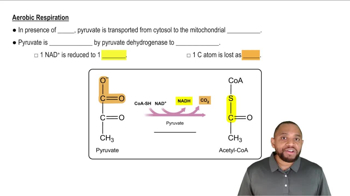
The conversion of pyruvate to acetyl-CoA is a key step in cellular respiration, linking glycolysis to the citric acid cycle. This process occurs in the mitochondria and involves the decarboxylation of pyruvate, releasing carbon dioxide and producing NADH. It is essential to recognize that this conversion does not directly produce ATP but is critical for subsequent ATP generation in the citric acid cycle.
Recommended video:
Guided course
1:38
Pyruvate Oxidation Concept 2

Aerobic Respiration

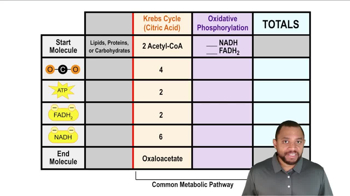
Aerobic respiration is the process by which cells convert glucose and other substrates into energy in the presence of oxygen. This process includes glycolysis, the citric acid cycle, and oxidative phosphorylation, leading to a high yield of ATP. Understanding the role of oxygen and the efficiency of ATP production in aerobic conditions is vital for analyzing energy outputs from metabolic pathways.
Recommended video:
Guided course
2:46
Aerobic Respiration Summary Concept 1