Pearson+ LogoPearson+ Logo
Ch.22 Carbohydrate Metabolism
McMurry - Fundamentals of GOB 8th Edition
McMurry8th EditionFundamentals of GOBISBN: 9780134015187Not the one you use?Change textbook
Chapter 22, Problem 47c

How many moles of ATP are produced by phosphorylation in the following?
c. Catabolism of 1 mol of acetyl-CoA in the citric acid cycle

Verified step by step guidance
1
Understand the context: The citric acid cycle (also known as the Krebs cycle or TCA cycle) is a central metabolic pathway that generates energy. When 1 mole of acetyl-CoA enters the cycle, it produces reduced coenzymes (NADH and FADH2) and GTP, which are later used to generate ATP through oxidative phosphorylation.
Determine the products of the citric acid cycle for 1 mole of acetyl-CoA: Each cycle produces 3 moles of NADH, 1 mole of FADH2, and 1 mole of GTP (which is equivalent to 1 mole of ATP).
Calculate the ATP yield from NADH: Each mole of NADH generates approximately 2.5 moles of ATP during oxidative phosphorylation. Multiply the 3 moles of NADH by 2.5 to determine the ATP contribution from NADH.
Calculate the ATP yield from FADH2: Each mole of FADH2 generates approximately 1.5 moles of ATP during oxidative phosphorylation. Multiply the 1 mole of FADH2 by 1.5 to determine the ATP contribution from FADH2.
Add the ATP contributions: Sum the ATP from NADH, FADH2, and the 1 mole of GTP (equivalent to ATP) to find the total number of moles of ATP produced from the catabolism of 1 mole of acetyl-CoA in the citric acid cycle.

Verified video answer for a similar problem:

This video solution was recommended by our tutors as helpful for the problem above.
Video duration:
4m
Was this helpful?

Key Concepts

Here are the essential concepts you must grasp in order to answer the question correctly.

Citric Acid Cycle

The citric acid cycle, also known as the Krebs cycle, is a series of enzymatic reactions that occur in the mitochondria. It plays a crucial role in cellular respiration by oxidizing acetyl-CoA to produce energy-rich molecules, including NADH and FADH2, which are later used in the electron transport chain to generate ATP.
Recommended video:
Guided course
2:31
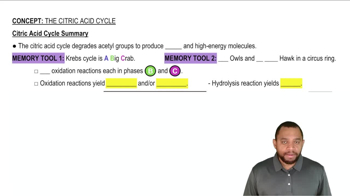
Citric Acid Cycle Summary Concept 12

Acetyl-CoA

Acetyl-CoA is a central metabolite in energy production and biosynthesis. It is formed from carbohydrates, fats, and proteins and serves as the primary substrate for the citric acid cycle, where it is converted into carbon dioxide and high-energy electron carriers, ultimately contributing to ATP synthesis.
Recommended video:
Guided course
1:33
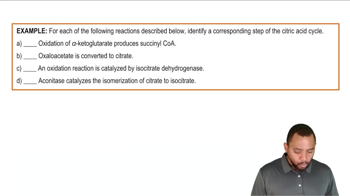
Phase B - Succinyl CoA Formation Example 2

ATP Yield

The ATP yield from the catabolism of acetyl-CoA in the citric acid cycle is typically around 10 ATP molecules per acetyl-CoA. This includes ATP generated directly through substrate-level phosphorylation and the ATP produced indirectly via oxidative phosphorylation from the NADH and FADH2 generated during the cycle.
Recommended video:
Guided course
03:09
Percent Yield