Indietro
Problema 17b
Provide an arrow-pushing mechanism for the following hypothetical base half-reactions.
(b)
Problema 17c
Provide an arrow-pushing mechanism for the following hypothetical base half-reactions.
(c)
Problema 18c
Provide an arrow-pushing mechanism for the following acid–base reactions.
(c)
Problema 18d
Provide an arrow-pushing mechanism for the following acid–base reactions.
(d)
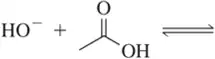
Problema 19
Acid–base reactions are reversible. Show a mechanism for the reverse of the reactions in Assessment 4.18.
Problema 20a(i,ii,iii)
In the following reactions,
(i) identify the acid and base,
(ii) identify the most electron-rich atom in the base,
(iii) identify the most acidic hydrogen in the acid,
(a)
Problema 20a(iv,v)
In the following reactions,
(iv) provide an arrow-pushing mechanism of the proton transfer that will occur, and
(v) predict the product of the reactions. [You'll need to provide the lone pairs here.]
(a)
Problema 20b(i,ii,iii)
In the following reactions,
(i) identify the acid and base,
(ii) identify the most electron-rich atom in the base,
(iii) identify the most acidic hydrogen in the acid,
(b)
Problema 20b(iv,v)
In the following reactions,
(iv) provide an arrow-pushing mechanism of the proton transfer that will occur, and
(v) predict the product of the reactions. [You'll need to provide the lone pairs here.]
(b)
Problema 20c(iv,v)
In the following reactions,
(iv) provide an arrow-pushing mechanism of the proton transfer that will occur, and
(v) predict the product of the reactions. [You'll need to provide the lone pairs here.]
(c)
Problema 20c(i,ii,iii)
In the following reactions,
(i) identify the acid and base,
(ii) identify the most electron-rich atom in the base,
(iii) identify the most acidic hydrogen in the acid,
(c)
Problema 20d
In the following reactions,
(i) identify the acid and base,
(ii) identify the most electron-rich atom in the base,
(iii) identify the most acidic hydrogen in the acid,
(iv) provide an arrow-pushing mechanism of the proton transfer that will occur, and
(v) predict the product of the reactions. [You'll need to provide the lone pairs here.]
(d) H2O + HCl ⇌
Problema 21c
Write the Keq expression for the following acid–base reactions. [You don't need to calculate Keq here.]
(c)
Problema 22a
Given the value of Keq for the following acid–base reactions, identify the weakest acid and the weakest base.
(a)
Problema 22b
Given the value of Keq for the following acid–base reactions, identify the weakest acid and the weakest base.
(b)
Problema 22c
Given the value of Keq for the following acid–base reactions, identify the weakest acid and the weakest base.
(c)
Problema 23a
Given the Keq values for the following acid–base reactions, identify the strongest acid and the strongest base.
(a)
Problema 23b
Given the Keq values for the following acid–base reactions, identify the strongest acid and the strongest base.
(b)
Problema 23c
Given the Keq values for the following acid–base reactions, identify the strongest acid and the strongest base.
(c)
Problema 24
An unknown base (B⁻) has been identified as very weak. What does this tell you about the strength of its conjugate acid, HB? Is it stable or unstable? Is it reactive or unreactive?
Problema 25a
An unknown acid (HA) has been identified as very strong. What does this tell you about the stability of the conjugate base, A⁻? Is it strong or weak? Is it reactive or unreactive?
Problema 26
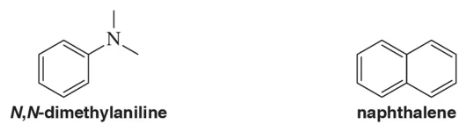
Design an acid–base extraction scheme to separate a mixture of the basic amine N,N-dimethylaniline and naphthalene.
Problema 28
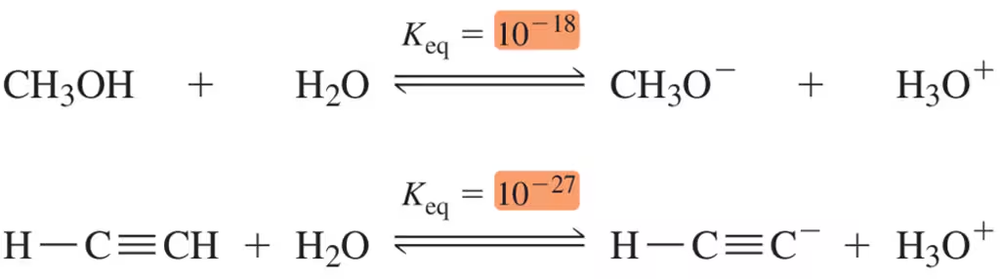
Given the following Keq values, how much stronger of an acid is methanol (CH3OH) than acetylene (HC≡CH)?
Problema 29
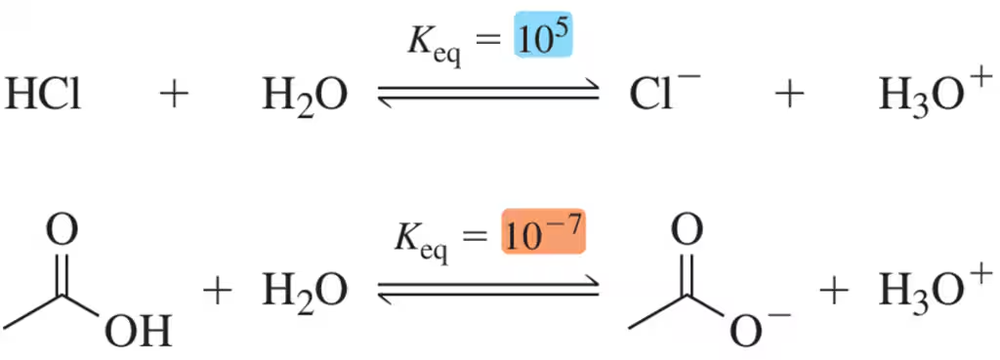
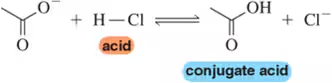
Given the following Keq values, how much stronger of a base is acetate (CH3CO2-) than chloride (Cl⁻)?
Problema 30a
Given that the indicated pKa values correspond to the acid dissociation reactions shown, calculate the ratio of acid to conjugate base for the reactions shown.
(a)
Problema 30b
Given that the indicated pKa values correspond to the acid dissociation reactions shown, calculate the ratio of acid to conjugate base for the reactions shown.
(b)
Problema 31
Hydrogen gas (H2) has a relatively high pKa value. Is it a stable or unstable acid? Do you expect it to participate in acid–base reactions?
Problema 32
How do you know that a proton with a low pKa value is acidic (besides 'I just remember')?
Problema 33
If a base has a conjugate acid with a high pKa value, is it stable or unstable? How do you know this is true (besides 'I just remember')?
Problema 36a
Using qualitative reasoning for the acid–base reactions shown,
(i) which is stronger, the acid or the conjugate acid?
(ii) Which side of the reaction is favored?
(iii) Would you expect a Keq greater than, equal to, or less than 1?
(a)