뒤로
뒤로
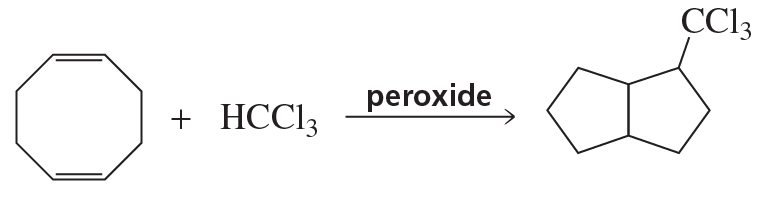
문제 34
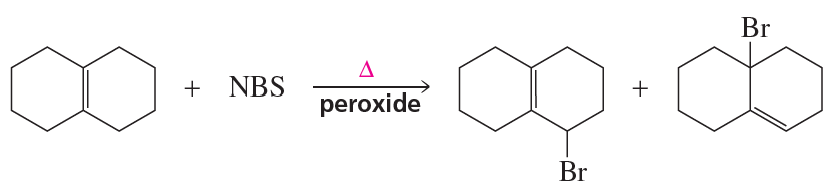
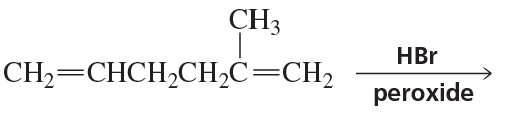
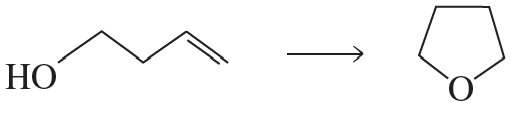
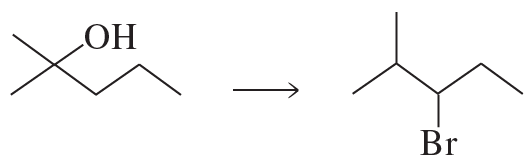
Propose a mechanism to account for the products formed in the following reaction:
문제 35
The deuterium kinetic isotope effect for the halogenation of an alkane is defined in the following equation, where X・ = Cl・ or Br・
Predict whether chlorination or bromination would have a greater deuterium kinetic isotope effect.
문제 37a
How many monochlorination products can be obtained from the radical chlorination of methylcyclohexane? Disregard stereoisomers.
문제 37b
Which product would be obtained in greatest yield? Explain.
문제 37c
How many monochlorination products would be obtained if all stereoisomers are included?
문제 38a
What five-carbon alkene forms the same product whether it reacts with HBr in the presence of a peroxide or with HBr in the absence of a peroxide?
문제 38b
Draw the structures of four six-carbon alkenes that form the same product, whether they react with HBr in the presence of a peroxide or with HBr in the absence of a peroxide.
문제 39a
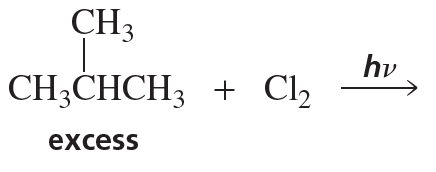
What alkyl halide will be obtained in greatest yield? Ignore stereoisomers.
a.
문제 39b
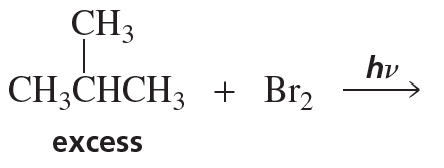
What alkyl halide will be obtained in greatest yield? Ignore stereoisomers.
b.
문제 39c
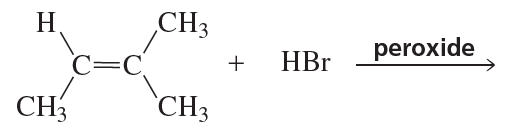
What alkyl halide will be obtained in greatest yield? Ignore stereoisomers.
c.
문제 39d
What alkyl halide will be obtained in greatest yield? Ignore stereoisomers.
d.
문제 39e
What alkyl halide will be obtained in greatest yield? Ignore stereoisomers.
e.
문제 39f
What alkyl halide will be obtained in greatest yield? Ignore stereoisomers.
f.
문제 40b
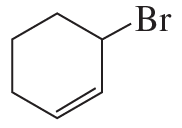
Starting with cyclohexane, how could the following compounds be prepared?
b.
문제 40c
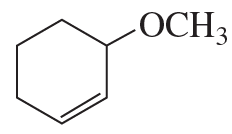
Starting with cyclohexane, how could the following compounds be prepared?
c.
문제 40e
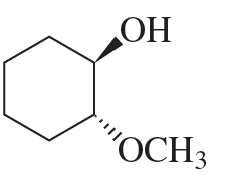
Starting with cyclohexane, how could the following compounds be prepared?
e.
문제 41a
Propose a mechanism for the following reaction:
문제 41b
Given that ∆H° for the reaction is -42 kcal/mol and the bond dissociation enthalpies for the C−H, C−Cl, and O−H bonds are 101, 85, and 105 kcal/mol respectively, calculate the bond dissociation enthalpy of the O−Cl bond.
문제 43a
Using the given starting material and any necessary organic or inorganic reagents, indicate how the desired compounds could be synthesized:
a.
문제 43c
Using the given starting material and any necessary organic or inorganic reagents, indicate how the desired compounds could be synthesized:
c.
문제 44
A chemist wanted to determine experimentally the relative ease of removing a hydrogen atom from a tertiary, a secondary, and a primary carbon by a chlorine radical. He allowed 2-methylbutane to undergo chlorination at 300 °C and obtained as products 36% 1-chloro-2-methylbutane, 18% 2-chloro-2-methylbutane, 28% 2-chloro-3-methylbutane, and 18% 1-chloro-3-methylbutane. What values did he obtain for the relative ease of removing a hydrogen atom from tertiary, secondary, and primary hydrogen carbons by a chlorine radical under the conditions of his experiment?
문제 45
At 600 °C, the ratio of the relative rates of formation of a tertiary, a secondary, and a primary radical by a chlorine radical is 2.6 : 2.1 : 1. Explain the change in the degree of regioselectivity compared to what was found in Problem 44.
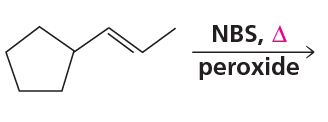
문제 46c
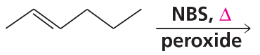
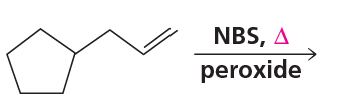
Draw the products of the following reactions, including all stereoisomers:
c.
문제 46d
Draw the products of the following reactions, including all stereoisomers:
d.
문제 46e
Draw the products of the following reactions, including all stereoisomers:
e.
문제 46f
Draw the products of the following reactions, including all stereoisomers:
f.
문제 47a
Calculate the ∆H° value for the following reaction:
문제 48
A possible alternative mechanism to that shown in Problem 47 for the monochlorination of methane involves the following propagation steps:
How do you know that the reaction does not take place by this mechanism?
문제 49
Propose a mechanism for the following reaction:
문제 50
Explain why the rate of bromination of methane decreases if HBr is added to the reaction mixture.