Ch. 13 - Alcohols, Ethers and Related Compounds: Substitution and Elimination
Mullins - Organic Chemistry: A Learner Centered Approach 1st Edition
Mullins1st EditionOrganic Chemistry: A Learner Centered ApproachISBN: 9780137566471당신이 사용하는 게 아니라요?교과서 변경
12장, 문제 39

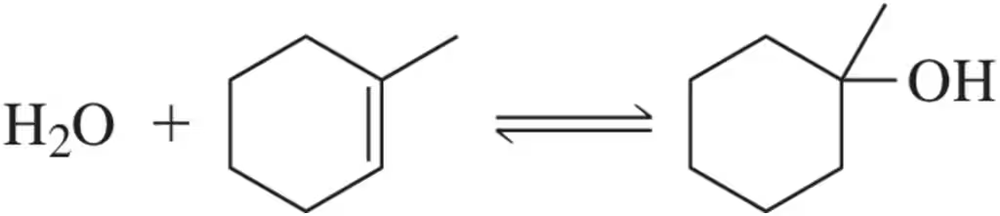
Predict which side of the equilibrium is favored by ∆H, ∆G, and ∆S.
Chemical reaction diagram showing water and a hexagonal structure converting to a hexagonal structure with an OH group.

검증된 단계별 안내
1
Step 1: Analyze the reaction provided. The reaction involves the addition of water (H₂O) to a cyclohexene molecule, resulting in the formation of cyclohexanol. This is a hydration reaction.
Step 2: Consider the enthalpy change (∆H). Hydration reactions typically release energy because bonds are formed in the product (cyclohexanol) that are stronger than the bonds broken in the reactants. Therefore, ∆H is likely negative, favoring the product side.
Step 3: Evaluate the entropy change (∆S). The reaction involves combining two molecules (H₂O and cyclohexene) into one molecule (cyclohexanol). This results in a decrease in the number of particles, leading to a decrease in entropy (∆S is negative). A negative ∆S favors the reactant side.
Step 4: Assess the Gibbs free energy change (∆G). The relationship between ∆G, ∆H, and ∆S is given by the equation: ΔG=ΔH-TΔS. At lower temperatures, the negative ∆H may dominate, favoring the product side. At higher temperatures, the negative ∆S may dominate, favoring the reactant side.
Step 5: Predict the equilibrium position. If ∆G is negative, the equilibrium will favor the product side (cyclohexanol). If ∆G is positive, the equilibrium will favor the reactant side (cyclohexene and H₂O). The temperature plays a crucial role in determining which side is favored.

비슷한 문제에 대한 검증된 영상 답변:

이 영상 해법은 위 문제에 도움이 된다고 튜터들이 추천한 것입니다.
영상 길이:
6m

주요 개념

질문에 올바르게 답하기 위해 반드시 이해해야 하는 핵심 개념들은 다음과 같습니다.

Le Chatelier's Principle

Le Chatelier's Principle states that if a dynamic equilibrium is disturbed by changing the conditions, the position of equilibrium shifts to counteract the change. In the context of the given reaction, adding or removing reactants or products will influence which side of the equilibrium is favored, helping to predict the direction of the reaction.
추천 영상:
04:12
The Electron Configuration

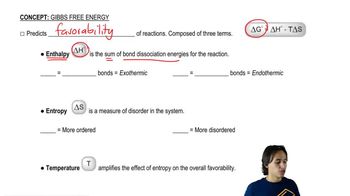
Gibbs Free Energy (∆G)

Gibbs Free Energy (∆G) is a thermodynamic potential that measures the maximum reversible work obtainable from a thermodynamic system at constant temperature and pressure. A negative ∆G indicates that a reaction is spontaneous and favors the products, while a positive ∆G suggests that the reactants are favored. Understanding ∆G is crucial for predicting the favorability of the equilibrium position.
추천 영상:
05:02
Breaking down the different terms of the Gibbs Free Energy equation.

Enthalpy (∆H) and Entropy (∆S)

Enthalpy (∆H) refers to the heat content of a system, while Entropy (∆S) measures the disorder or randomness of a system. The relationship between these two concepts, along with temperature, is described by the Gibbs Free Energy equation (∆G = ∆H - T∆S). Analyzing ∆H and ∆S helps determine the thermodynamic favorability of a reaction and the direction in which the equilibrium will shift.
추천 영상:
02:46
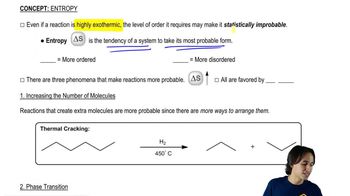
Explaining what entropy is.